Showing posts with label Conservative party. Show all posts

Wednesday, 7 June 2017

The UK General Election and Brexit: Comparing Party Manifestos


Professor Steve Peers

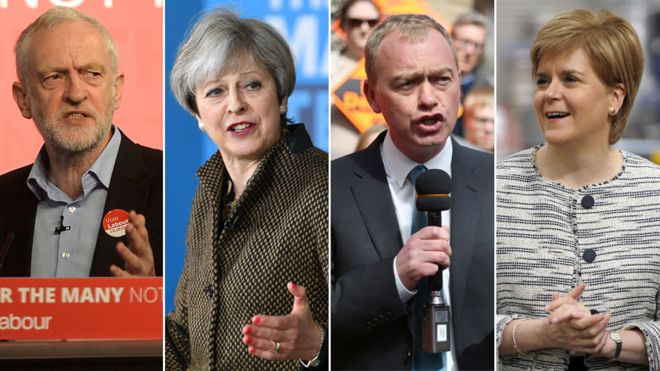
Tomorrow sees another general election in the UK, just two years after the last one. Since this is (according to the Prime Minister) an election on Brexit, it seems appropriate to review the parties’ views on this issue, including future UK/EU relations. I will examine the parties’ views in turn – focussing on larger UK-wide parties plus (due to its political importance) the Scottish National Party. The final section is an overview and comparison.

Conservatives

The Tory manifesto position on Brexit is largely a summary of the position set out in the Brexit White Paper (discussed here), and the planned Great Repeal Bill (discussed here), which would keep EU law as part of ‘UK law’ for the time being. Essentially, the Tories believe that the future UK/EU relationship should be based on a free trade deal without ‘vast’ payments into the EU budget or free movement of persons. Participation in the customs union and internal market would end, and there are some details about the transition to full separate UK participation in the World Trade Organisation. There’s an objective of continuing security cooperation with the EU, but the details are not spelled out.

Some fair settlement of UK accounts would be made upon departure from the EU, but the Tory policy is ‘no deal is better than a bad deal’ – without spelling that position out further. Fortunately, the UKIP manifesto (discussed below) addresses this point. Unlike UKIP, the Tories do not attempt to ‘sell’ the no-deal scenario – which is just as well considering the concerns about its potential economic damage. Rather there is much discussion of what the positive outcomes of a deal would be.

Future immigration policy would retain an objective of net immigration below 100,000 – which would entail reducing non-EU migration (an issue largely outside the scope of EU law for the UK) as well. This would include further restricting the number of foreign students and family members, despite promises from the Leave side made during the referendum campaign to make it easier to admit UK citizens’ non-EU family members.  

Labour

Labour accepts the result of the referendum but sets out in more detail than the Conservatives what the future UK/EU relationship would look like.  It supports continued relations with Euratom and the single energy market, plus wants to maintain the ‘benefits’ of the single market and customs union without explaining how. Other remarks from the party suggest that it opposes continued participation as such in the single market and customs union, and opposes free movement of persons continuing.

Labour reject the ‘no-deal’ option, support a transitional deal, and list a number of areas where they still wish to cooperate with the EU: research programmes, Erasmus, Europol, Eurojust, the European Arrest Warrant (EAW), climate and anti-terrorism cooperation.  They have a different policy from the Tories on future family migration, as they would waive the strict income requirements for family members rather than tighten them. (There would still be a requirement not to use public funds). They would ‘guarantee existing rights’ of EU citizens in the UK. They set out in detail their future trade policy, insisting on links between trade and other concerns like the environment and human and labour rights.

Liberal Democrats

The LibDems aim for a referendum on the final Brexit deal, and support continued membership of the EU single market (including free movement of people) and customs union. They make specific reference to staying in Erasmus, preserving social and environmental rights, and participating in Europol, the EAW, EU databases, EU research funds, the European health card, abolition of roaming fees, and pat passports. Like Labour, they suggest links in between human rights and the environment in future trade deals. LibDems also give some detail on the position of EU citizens in the UK:

Greens

Similar to the LibDems, Greens propose a referendum on the final Brexit deal, and seek to continue with free movement and the single market. They also wish to guarantee EU citizens’ rights, retain social and environmental safeguards, and link trade deals to other standards.

Scottish National Party

The SNP manifesto views on Brexit reiterate its two key positions: Scotland, or the UK as a whole, to stay in the single market (previously discussed here), and a Scottish independence referendum when the terms of Brexit are known (previously discussed here). They also repeat their support for guaranteeing EU citizens’ rights.

UKIP

Finally, that brings us to the UKIP manifesto. This manifesto gives us an indication of how the ‘no-deal’ scenario hinted at in the Conservative manifesto might play out. UKIP opposes the use of the Article 50 procedure to negotiate with the EU, focussing instead on the purely domestic law change of repealing the European Communities Act. They still aspire to a free trade deal with the EU, however, although they are indifferent to whether they get one – since they also promise to spend the £11 billion “windfall” from tariffs on EU goods. There’s no acknowledgement of the effects on the UK economy of this scenario: indeed, they argue that talk of a “cliff edge” from leaving the EU without a trade deal is “hyperbole”, since trade will still continue. This ignores the obvious prospect that the level of trade will decrease if tariffs and non-tariff barriers are imposed. While they reject the single market and customs union, they want EU/UK trade to continue “on the same basis as present”.

In any event, UKIP not only refuse to make any payment upon departure, they expect the UK to receive a sum from the EU as it leaves. Moreover, they pledge to oppose the existence of customs unions like the EU in the World Trade Organisations – even though the WTO expressly provides for the existence of customs unions, and (as UKIP even acknowledge) the EU is a WTO member in its own right.

Overall then, UKIP expects to receive all the current trade benefits of EU membership, with none of the perceived drawbacks, plus a payment on the way out. All of this while refusing to use the official departure route and campaigning to end the EU’s existence as a customs union and WTO member. If you seek a visual metaphor for how UKIP sees the world, imagine their leader Paul Nuttall – a star football player in his own mind - repeatedly scoring penalties over the heads of 27 massed goalkeepers.

UKIP’s rage against the dying of their light deserves one final paragraph. Their immigration policy includes not just an unreal zero migration target, but also a demand that new immigrants observe UK “values” to be admitted. This from a party who have continually disregarded the basic British values of tolerance, equality and fair play: members have referred to gays causing floods, and repeatedly insulted minorities. Indeed, after the last European Parliament election, to receive EU money UKIP did a deal with a party whose leader denies the Holocaust, and claims that women are inferior and obtain their political beliefs via biological transmission from the men they have sexual intercourse with. Clearly, politics’ loss is gynaecology’s gain.

Overview

There are two broad categories of opinion on the EU in this election, but also important differences within each group. The Liberal Democrats, Greens and SNP want to continue participation in the single market as well as a number of other EU policies. Moreover, all three parties want to offer the option of continued EU membership – the LibDems and Greens by means of a UK-wide referendum on the final deal, and the SNP by means of a referendum on Scottish independence.

The Conservatives, Labour and UKIP all favour departure from the UK without the single market, the customs union and free movement of persons, and aim instead for a free trade deal with the EU. However, these similarities soon end.  Like the first group of parties, Labour would guarantee EU citizens’ rights (in fact, it supports guaranteeing their existing rights, an important nuance), and would seek participation in a number of specific EU measures. The Tories are considerably cooler and less detailed on these issues, and are willing to contemplate a ‘no-deal’ scenario, although they cannot bring themselves to ‘sell’ it. Labour would welcome foreign families and students; the Tories see them as numbers to be reduced.

UKIP offers voters not just one fantasy, but a choice of two fantasies: either a problem-free ‘no-deal’ scenario, or a deal with all of the benefits and none of the supposed drawbacks of EU membership, with a gold watch for UK service to the EU thrown in for good measure. Of course, some would argue that UKIP’s fantasies are simply more explicit than Labour’s or the Conservatives’ – since the EU has made clear in its negotiating position that it is not possible to retain all benefits of the single market for a former Member State which leaves it.

Voters may not wish to make Brexit the main reason for their vote, or may in any event choose to cast a tactical vote against a party they dislike, rather than vote for a party which they most agree with but which has no chance of winning their seat. But it can hardly be said that all parties take the same view on Brexit issues, and the summary above makes clear that for those whose concern is Brexit first and foremost, there is a lot at stake in this election.


Barnard & Peers: chapter 27
Photo credit: BBC

Friday, 29 May 2015

The Referendum Bill: politics and law


Steve Peers

Yesterday’s publication of the Referendum Bill fired the starting pistol in the process of renegotiating the UK’s membership of the EU, and holding an ‘in-out’ referendum on the results. I’ll look at two different elements of the Bill: the parliamentary process and its main contents. It inevitably leaves some issues out, since a Referendum Bill is only meant to deal with the basic referendum process, not with the substantive questions like the content of the renegotiation or the consequences of withdrawal.

Parliamentary process

Although some press reports give the impression that the contents of the Bill are already law, this is obviously not the case. Every Bill must be approved by both Houses of Parliament before it becomes law. Even then, it would always be possible to amend the ensuing Act of Parliament.

Will the Referendum Bill become an Act of Parliament? Yes, that’s virtually certain. The principle of a referendum on EU membership is not only supported by the Conservative majority in the House of Commons, but also (following a recent U-turn) by the Labour party. That should ensure that a Referendum Act can get through both the Commons and the Lords.

However, the devil is in the details. It’s still possible that the Bill could be amended, particularly as regards the issues discussed below (the question, the timing and the franchise).  In the last majority Conservative government, the Bill to ratify the Maastricht Treaty ran in to endless trouble at the hands of an alliance of Labour and Eurosceptic Tory MPs. The current Conservative government has a similar slim majority in the House of Commons, and while there are fewer Labour MPs, there are more Eurosceptic Tories. Time will tell whether these two groups (perhaps in conjunction with the big contingent of Scottish National Party MPs?) can find common cause as regards any amendments.

The Bill also has to pass the House of Lords, of course. While it is unlikely to be defeated as such there (in part because of the ‘Salisbury Convention’, which provides that the House of Lords will not oppose the principle of Bills which were set out in the winning party’s manifesto), again there may be attempts to amend the details. The political dynamics are different, since the Conservative party does not have a majority. While the House of Commons can override the House of Lords if need be, by use of the Parliament Acts, this would cause a one-year delay in the entry into force of the law, scuppering any plan to hold the referendum in 2016.  


Main contents

Most of the Bill sets out the dry but necessary detail of the mechanics of holding the referendum. But it does address three key issues: the timing, the question and the franchise (ie, who can vote). I will address these issues in turn.

First of all, the timing. As promised by the Conservative party, the Bill sets a deadline of end-2017 for the Referendum to take place. A referendum in the midst of Christmas shopping is highly unlikely, so the latest realistic date would be November 2017. In fact, the real issue is whether the referendum might be held earlier, sometime in 2016. There’s been some speculation that it might be held in May 2016, on the same date as elections in London, Scotland and Wales. Ideally, as recommended by the Electoral Commission, the referendum should not be held the same day as other elections, to ensure that voters are completely focussed on the separate choices facing them.  Furthermore, holding the referendum on the same day as elections in pro-EU areas such as Scotland and London will give rise to suggestions that the poll is biased, which it is better to avoid.

Secondly, the question. The Bill suggests the following question:

“Should the United Kingdom remain a member of the European Union?”

Some have objected to the word ‘remain’, because it allegedly biases the question in favour of staying in. However, I see no problem in referring to an objective fact: the UK is indeed currently a member of the EU. Indeed, the Electoral Commission recommended the word ‘remain’ rather than ‘in’, because apparently some people are unaware that the UK is currently a member of the EU. I am hoping that none of my former students are among them!

It will still be fully open to the ‘Out’ side to try to convince the public that our current EU membership is a bad thing. Indeed, their whole argument will presumably rest on the awful consequences of being (and indeed remaining) an EU member.

Having said that, it would be preferable not to give either side the supposed advantage of being the ‘Yes’ side. A better question would therefore be ‘Should the UK remain a member of the European Union, or leave?’ with the possible answers being ‘remain’ or ‘leave’.

Some have suggested that there should be multiple questions on the ballot paper, namely a chance to vote for the current status quo of EU membership, as well as withdrawal or Cameron’s renegotiated version (see Jon Worth’s blog for how this could work). The argument against this is simply democratic legitimacy: the Conservative party won a majority in the House of Commons on the basis of holding an in/out referendum on the renegotiated terms.

This brings me to the vexed question of the franchise. The Bill proposes to use the franchise for general elections: citizens of the UK, Ireland and Commonwealth countries over 18 years old living in the UK, and UK citizens living abroad for less than 15 years. But it proposes to add members of the House of Lords and residents of Gibraltar. I have already blogged on the reasons why the general election franchise should be used, due to concerns about legitimacy as well as tactics. (See also the analysis by Jo Shaw here). But some have suggested that it may be illegal to ban EU citizens in the UK from voting in the referendum: see the arguments by Richard Edwards here and by Albert Sanchez Graells here

Let’s examine these legal arguments in more detail. The obvious argument against the right of EU citizens to vote in the referendum is the list of EU citizens’ rights in Article 20 TFEU. That list includes the right to vote in local and European Parliament (EP) elections, but does not mention other elections. Article 25 TFEU then says that for EU citizens to have more rights, a further Council Decision has to be agreed and ratified. In the absence of such a decision, they surely do not have further electoral rights. The general references to democracy in the Treaties aren’t very specific, and mostly (for instance in Article 10 TEU) refer to the EU institutions only. It can’t be seriously argued that the ‘general principles’ of EU law require all EU citizens to vote in referenda, in the absence of any widespread practice to that effect (even Ireland does not allow UK citizens to vote in referenda).

The EU Charter of Rights doesn’t help either. It only mentions the rights to vote in local and EP elections, and Article 52(2) of the Charter makes clear that these provisions of the Charter do not add anything to the citizenship provisions of the Treaties. Anyway, the Charter only applies where there is a link to EU law, and although the process of withdrawal from the EU is referred to in Article 50, Article 50(1) in turn refers to the national law of individual Member States as regards the decision on whether to withdraw. It couldn’t be any clearer that it’s entirely up to each Member State to decide who votes in a withdrawal referendum. And for those contemplating litigation on this issue: do you seriously think that the prospects of an ‘In’ vote (and British citizens’ regard for the EU more generally) could possibly be helped by a EU or ECHR court (or a UK court doing their bidding) ordering Parliament to allow EU citizens to vote in the referendum?


Barnard & Peers: chapter 2

Image credit:

Friday, 8 May 2015

Is Brexit inevitable? The UK’s EU membership after the General Election


Steve Peers

The unexpected election of a Conservative majority government in the UK raises some fundamental questions about the UK’s continued membership of the European Union. As a first response to the election results, I’ll discuss here in turn the issues relating to the referendum and the renegotiation.

The Brexit referendum

What are the key issues of principle concerning the upcoming referendum?

First of all, let’s start with the obvious point: the new government will implement the Conservative party’s policy of attempting to renegotiate the UK’s membership of the European Union, followed by an in-out (‘Brexit’) referendum on the results of the referendum by the end of 2017. A government bill to this effect will likely be swiftly introduced; it will probably be similar to the Private Member’s Bill tabled on this issue in the last parliament, which was supported by the Conservative party.

Secondly, as I blogged last year, the opposition of many pro-Europeans to a referendum was both a mistake in principle, and a tactical error too. There’s clearly no point in expending any political energy on resisting a referendum any further.  The issue for the pro-EU side is now how to win the referendum.

Thirdly, the idea of trying to expand the voting franchise to cover all EU citizens living in the UK is a moot point in light of the outcome of the election. That’s simply because the Conservatives have the votes to push through (as they proposed in the prior Bill) a referendum based on the usual UK general election franchise (UK, Irish and Commonwealth citizens living in the UK, and UK citizens who have lived abroad for less than 15 years). Indeed, as I blogged earlier this year, while I sympathise with EU citizens living in the UK who would like to vote in a Brexit referendum, it would again be both wrong in principle and a tactical error to expand the franchise for that referendum.

Thirdly, there’s no particular reason to assume, as some inside and outside the EU do, that the anti-EU side will win the referendum. Rather the contrary: according to polling, support for staying in has risen in recent years, and clearly exceeds the support for leaving. That’s before any renegotiation takes place. Of course, we might not want to rely on polling so much in light of the election result - although the lead for the pro-EU side in this poll is much larger than the error in opinion polls during the general election. There’s also no good reason to consider the election result as a de facto vote for Brexit: the Conservative party was arguing for a renegotiation and referendum, not Brexit as such, and did not even get near 40% of the vote in any case. In a referendum, there is no ‘first past the post’ to distort the outcome of the public choice between multiple parties – only a straight ‘yes or no’ decision.

Renegotiation

There are three important political dynamics that will shape the debate over renegotiation of EU membership – and therefore affect the ensuring referendum – in the two and a half years to come.

First of all, a key issue will be the relationship between David Cameron and the rest of his party, most notably the large Eurosceptic chunk of it. Cameron’s decision to promise a renegotiation and a referendum, and then to make immigration from the EU such a key feature of the renegotiation, was prompted by demands from his backbenchers and concerns about losing Tory votes to UKIP. The latter concern will surely now go on the back burner issue as a result of the general election; but could the former issue become more important? With a small majority, is Cameron now even more at the beck and call of his back-benchers?

The key issue here is whether Cameron will continue to respond to Eurosceptic demands to harden his negotiation position (or not to give any ground on the position he has already set out), or whether he will (on this issue at least) feel less pressure than before. After all, he has answered his internal party critics by winning a majority in the House of Commons – and he has less pressure on him as a result of his intention to retire by the end of this parliament. A crucial question here is whether he could count on other parties’ support, if necessary, in the event of a rebellion by his own Eurosceptic backbenchers.

There’s an important point of principle here. Not only does the Conservative party have a democratic mandate to hold a renegotiation and a referendum: it also has a mandate to hold that renegotiation on the terms that Cameron has already set out. Some Eurosceptics believe that the UK could demand any renegotiation terms it liked from the rest of the EU, and automatically get them. But the lack of enthusiasm from other Member States for Cameron’s demands so far suggests that the Conservative party’s demands are already at (if not beyond) the limits of what other Member States could be willing to accept. Those Eurosceptics who feel that his current renegotiation demands are not enough should join the pro-Brexit camp openly and honestly, instead of trying to trick Cameron into making unrealistic demands in the hope that other Member States’ rejection of them would compel Cameron to give up on renegotiation and campaign for Brexit himself.

Secondly, a key issue is what other Member States now do following the general election result. There seemed to be little interest in discussing the renegotiation requests before, but that was understandable for two obvious reasons. First of all, because of the pending general election: why start to renegotiate with someone who might soon lose office? Secondly, because (and this was widely misunderstood) the British government never requested a renegotiation; it was Conservative party policy only. In the absence of agreement on Cameron’s strategy from the Liberal Democrats, the UK government as such never requested a renegotiation.

Both those obstacles to talks have now been removed. The question is whether other Member States are now inclined to respond to the requests for renegotiation or not. The response of key Member States like Germany, and traditional friends of the UK like the Netherlands and Ireland, will be crucial. While some Member States may think ‘this is too politically difficult for us’ or ‘if you don’t like the EU, just go away’, this would be a mistake. As a net contributor to the EU budget and a net importer of goods from the EU, it would be foolish for other Member States to refuse to negotiate at all – although as I said already, that does not mean that the UK can expect the rest of the EU to accept any and all renegotiation demands it might wish to make.

The renegotiation process will raise some important legal questions about the form and substance that renegotiation will take. I have blogged about some of these points earlier, and will be coming back to them over the months ahead.

Thirdly, the role of other political parties in the UK will be crucial. As I already mentioned, Cameron might need their support in the event of a rebellion by Eurosceptic backbenchers. Tempting as it might be to cause trouble for Cameron, it’s not in the interests of pro-EU parties to jeopardise the UK’s EU membership, which they support. Because the Conservative party has a majority, other parties will have no direct influence on the renegotiation as such. But they have an indirect importance, because of their key role in ensuring a Yes vote in the Brexit referendum. This can hardly be secured by Tory votes alone, given that the party attracts under 40% of the vote, including many anti-EU voters.

This has implications for the content of the renegotiation. Many Tories would love to see a renewed opt-out from the social chapter; but many voters on the left might reject staying in the EU on that basis (even if it could be negotiated with other Member States). Anything beyond a modest curtailment of the EU’s working time Directive (for instance, overturning the wacky CJEU case law counting doctors’ sleep as ‘working time’) could risk an anti-EU vote.

Furthermore, this means that pro-EU opposition parties will have to share a platform with (some) Tories – even though we can be certain that after two years of Tory government there will be utter loathing of that idea. But a ‘no’ to the EU will not force the Tory government out, or even cause Cameron to resign (it’s widely assumed that he would resign as Tory leader shortly after the Brexit vote anyway). And the most fervent supporters of the free movement of EU citizens will have to accept that some curtailment of free movement rights is an inevitable consequence of the renegotiation. Without it, there will soon be no free movement between the UK and EU at all.

As for the anti-EU parties (mainly UKIP and a big chunk of the Tories, with a smattering of politicians from other parties), the key issue will be whether they can sell a coherent and plausible alternative to the UK’s EU membership. This is another issue which I will come back to, since it raises many legal issues. But suffice it to say that the simplest alternative to EU membership (the European Economic Area) is unattractive to Eurosceptics because it still provides for free movement of people. Any other alternative will entail a negotiation of a new agreement with the other Member States. But the anti-EU side will not only have to agree a common view on what this would entail, but also convince the public that other Member States will necessarily accept it. Compare to the Scottish independence referendum last year, where the SNP government was able put forward a single detailed plan on what independence would look like (I doubt that the various Eurosceptics could easily agree on the equivalent) but could not then (as I blogged at the time) convince enough Scottish voters that the remaining UK would agree to it. This may prove to be the Achilles heel of the anti-EU side.

Finally, a more general point. The result of the general election is undoubtedly a great shock and disappointment to non-Tories like myself. But the prospect of a Brexit referendum offers us a chance to fight (alongside pro-EU Tories) for important things we believe in, well before the next general election: employment rights, environmental and consumer protection, human rights, animal welfare, openness to the outside world and economic prosperity through trade in goods and services and free movement of people.  Let's try to light this candle, not simply curse the darkness.


*This post is linked to research for my forthcoming book from Hart Publishing – Brexit: The Legal Framework for Withdrawal from the EU or Renegotiation of EU Membership


Barnard & Peers: chapter 2

Image: ConservativeHome.com

Wednesday, 15 April 2015

The UK's general election: a fundamental change to UK/EU relations?


Steve Peers

The result of the current British election campaign could be crucial for the future of the UK’s relations with the European Union. Every UK-wide election party which is likely to win seats in the election has now released its election manifesto, namely: the Conservatives; Labour; Liberal Democrats; UKIP; and the Greens. It’s therefore a good time to examine what the parties are saying about the EU, and what the various post-election scenarios would mean for the UK’s relations with the EU.

According to pollsters, at present the most probable outcome of the election is that no party will have an overall majority, although there is a small possibility that either the Labour party or the Conservative party will obtain enough seats for a majority. In the absence of a majority, either the Conservative party or the Labour party will try to obtain enough votes to govern from other parties, which are likely to include parties running in Wales, Scotland and Northern Ireland.  So it’s necessary to consider what these other parties’ view on the EU is, and (more indirectly) whether they are likely to support Labour or the Conservatives in office.

Of these parties, only the Welsh Plaid Cymru has released its manifesto already, but I will refer to the other parties’ positions to the extent that they have been announced to the press: the Scottish Nationalist Party (SNP) and the Democratic Unionist Party (DUP). I won’t discuss Sinn Fein, since it will not take up its seats in Parliament, or the Northern Irish Social Democratic and Labour Party, since it sits and votes with the UK-wide Labour party.

Party manifestos

There’s a lot in the manifestos that touches upon EU-related policy. For instance, the Liberal Democrats promise a ‘Digital Rights Bill’, which is closely related to EU laws on data protection and net neutrality. EU law also has a big impact on environmental law, consumer law and some other policies. But I will focus here on the key question of ‘Brexit’, ie the UK’s withdrawal from the EU.

The Conservative party re-iterates that party’s policy of renegotiating EU membership and then holding an in/out referendum by the end of 2017. The renegotiation would focus on free movement (‘immigration’) from the rest of the EU, although the manifesto also refers to changing the principle of ‘ever closer union’ of EU Member States, and protecting the interests of non-eurozone Member States.

The Labour party manifesto refers to specific EU reforms, including EU immigration issues. It promises an in-out referendum if there is a further transfer of powers from the UK to the EU  This policy pledge is a development of current legislation (the 2011 European Union Act), which requires a referendum already in the event of such transfer of powers – but not an in/out referendum. However, the party does not promise an in-out referendum relating to the renegotiation. Indeed, they have made much of their opposition to that prospect.

The Liberal Democrats also promise an in-out referendum if there is a further transfer of powers from the UK to the EU. In fact, it’s their long-standing policy. They don’t call for a referendum following renegotiation.

The UK  Independence Party reiterates its long-standing policy in favour of the UK leaving the EU. It calls for a referendum to be held ‘as soon as possible’, with the preferred question ‘Do you want Britain to be a free, independent and sovereign democracy?’. They support a negotiated withdrawal, rather than a unilateral departure.

The Green Party declares itself in favour of the EU, although supports reform of it, and favours holding an in/out referendum on EU membership. However, it seems unlikely that this party would support a Conservative-led government.

Plaid Cymru declares that it is pro-European, and makes no demand for a referendum. It also seems unlikely that this party would support a Conservative-led government. The SNP support the UK’s EU membership, but in the event of an in/out referendum, they would like the public in each region of the UK to have a veto on leaving. This party has expressly ruled out supporting a Conservative-led government. The Labour party has in turn ruled out a coalition with the SNP, although it has not ruled out less formal arrangements.  

Finally, according to press reports, the DUP supports an in-out referendum on EU membership. It’s not clear if they would support renegotiation first, or would like an immediate referendum along the lines of UKIP. The DUP has traditionally supported Conservative governments in the past, although the party has declared its willingness to negotiate with the Labour party as well. It’s not clear if they would insist upon an EU referendum as the price of their support of a Labour government (it would be superfluous to insist on one as a condition of supporting the Conservatives). It’s also not clear if, like the SNP and Plaid Cymru, they would insist that Northern Ireland would also have to vote in favour for Brexit to be valid, but I doubt that this is their view, since they traditionally seek stronger ties between Northern Ireland and the rest of the UK.

Analysing the manifestos

To make things simpler, I will assume that politicians will stick to the policies that they are promising. Of course, it’s always possible that politicians will break their promises; some might say that this is about as certain as death and taxes. But politicians do keep some promises, and in some cases there are strong pressures on them to keep those pledges. For instance, if David Cameron reneged on his renegotiation policy, he would not last 24 hours as leader of the Conservative party.

There are three different visions of the UK’s future with the EU on offer: an immediate Brexit referendum (favoured by UKIP); renegotiation followed by a referendum (supported by the Conservatives); or renegotiation without a referendum (supported by Labour and the Liberal Democrats).

The latter two parties do support a referendum in the event of a transfer of powers from the UK to the EU, but that would only happen if there were a Treaty amendment that other Member States appear to have little enthusiasm for. In the event that Eurozone Member States want new measures to ‘save the euro’, it’s possible to agree separate treaties or EU legislation among themselves (as they have before), or, if necessary, to agree on amendments to the EU Treaties which only apply to the Eurozone states, or which otherwise give the UK an opt-out. In that case, there would be no transfer of powers from the UK to the EU, and so no need for a referendum.  Simply put, an in/out referendum under the Labour or Liberal Democrat policies is very unlikely.

As for the details of the Brexit policies, I have commented already on the details of the Conservatives’ intentions to renegotiate the free movement rules, and so won’t repeat these points again.

While UKIP make much of the need for an unbiased referendum campaign, their suggested question is clearly biased. A genuine unbiased question would be: ‘Do you support the UK remaining a member of the European Union, or leaving it?’, with boxes for ‘remain’ and ‘leave’ (so that neither side has the supposed advantage of being the ‘Yes’ vote).  

The demand for regional voting on a Brexit referendum in the different parts of the UK is clearly incompatible with the constitution of the UK as it currently stands. It resembles the arrangements in federal states like Canada, Australia and Switzerland, where there are both national and regional thresholds for constitutional amendments. But the UK is not such a state – though whether it should be one is a rather broader question. In any event, it’s a moot point, since it would only arise in practice if the SNP is supporting a Conservative government – which it has said it won’t do.

Negotiations between parties

What happens if no party holds a majority? The exact composition of the next government will then depend on negotiations between the parties, which in turn depends on the exact numbers of seats each gets. It’s too early to predict that now. But some basic points can be made.

First of all, it’s simply not true, as Professor Tim Bale has pointed out, that the biggest party always gets to form the government. It’s rare for the second largest party to form one, but it’s entirely legal and consistent with constitutional convention if it does.

Secondly, the Liberal Democrats have clearly indicated via press reports their willingness to compromise on the Brexit issue, and to support the Conservative demand for a referendum subject to discussion of the details, such as the width of the voting franchise and the wording of the referendum question. A Brexit referendum is clearly a ‘red line’ (non-negotiable issue) for the Tories. So a renegotiation and referendum would be likely to take place if the Tories and Liberal Democrats hold a majority of seats between them, or if the Tories, Liberal Democrats and DUP hold a majority.

Thirdly, a coalition or other arrangement involving UKIP (Tory/UKIP; Tory/DUP/UKIP; Tory/LibDem/UKIP; Tory/LibDem/UKIP/DUP) might have difficulty agreeing on the Brexit issue, due to the different policy of UKIP. Some Conservative backbenchers would undoubtedly like to a see an immediate Brexit vote, but others in the party, and the Liberal Democrats, would not. But it would be awkward for UKIP to back down on its most important policy.

If Labour and the Liberal Democrats held a majority, or if Labour formed a government in most other scenarios (Labour/SNP; Labour/LibDem/SNP; Labour/SNP/Green/PC etc) a Brexit referendum is highly unlikely.

Finally, in the improbable event that Labour and the Conservative party do a deal, differences in the Brexit referendum policy would be one of many obstacles. But the far bigger issue would be managing the consequences of hell freezing over.

Passing EU-related legislation

Finally, would there be any difficulties legislating for Brexit? It can be assumed that a Tory-led government would immediately introduce a government bill to put into effect its planned referendum. One potential problem here is the House of Lords, which blocked a previous private member’s bill which aimed to put this policy into law. The so-called ‘Salisbury Convention’ means that the House of Lords does not block government bills which implement policies which were set out in the leading party’s manifesto. According to the House of Lords itself, the convention should only apply if all of the coalition parties have set out the same policy – but only the Tories (and likely the DUP) have set out a renegotiation and referendum plan in their manifesto. That could lead to the House of Lords blocking the referendum Bill. Although a majority in the House of Commons could use the Parliament Act to overrule the Lords, that would mean a year’s delay in the law coming into force, which might complicate renegotiation talks.

Art credit: Adam, Daily Telegraph

Barnard & Peers: chapter 2

Friday, 3 October 2014

Roadkill: the EU Charter of Rights after the Conservative party’s changes to UK human rights law


Steve Peers

Most drivers, at one time or another, have felt an unpleasant bump as their car ran over an unfortunate small animal which had chosen precisely the wrong time to scoot across the road. Some drivers are devastated, while others are mildly upset or indifferent. But a few are exhilarated at the thought that they have eliminated an irritating obstacle in the way of their unseemly rush to reach their destination.

The latter attitude aptly sums up the Conservative party’s attitude to the role of EU law in their proposals to reform UK human rights law, unveiled today.

I have already blogged on the problems with this proposal at a domestic level, but there are problems as regards its relationship with EU law too.  

First of all, we should be clear what today’s proposal does not do. There is a widespread perception that it suggests that the UK withdraw from the European Convention on Human Rights (ECHR). But it doesn’t suggest this, at least not yet. The assumption in the document is that the UK will remain a party to this Convention, although it raises the possibility that the UK will withdraw from it if the Council of Europe raises too many objections to today’s plans. This may simply be a concession to those who think that these proposals do not go far enough (!) in eviscerating human rights protection in UK law. So while I blogged this summer on what would happen to the UK’s EU membership if it withdrew from the ECHR, that question does not yet arise.

Nor does today’s proposal suggest that the UK should disapply the EU’s Charter of Rights in its domestic law. A House of Commons committee suggested that earlier this year. The idea is utterly bonkers, for the reasons I blogged on at the time. But again, it isn’t immediately relevant.

What today’s document does do is propose to weaken the domestic system of human rights protection, decouple it from the ECHR system and introduce new rules which weaken substantive protection of human rights for any group of people which the drafters of the proposal deem sufficiently despicable. How does that relate to EU law?

The key questions here are: are the new proposals compatible with EU law? If not, to what extent? And what are the consequences?

At the outset, we should note that the EU Charter of Rights and the rights protected by the ECHR don’t always overlap. So today’s proposals could not create any conflict where (a) the Charter applies, but the ECHR does not (as regards social rights, for instance), or (b) the ECHR applies, but the Charter does not – because the Charter only applies where there is a link to EU law, as the CJEU set out in the judgment in Fransson. There’s only a possible conflict where both the Charter and the ECHR apply to an issue.

What sort of cases would these be? I suggest three examples, although this isn’t an exhaustive list. First of all, any limitations on the right to a fair trial granted to criminal suspects which resulted from today’s proposals could conflict with the EU legislation on their rights  to interpretation and translation, and their rights to information about proceedings, which the UK has opted in to. (There are other EU measures and proposals in this area, but the UK hasn’t opted in to them).

Secondly, any requirement that telecommunications service providers retain data for handing over to law enforcement authorities falls within the scope of EU law, since that would constitute a derogation from the rule in the EU’s telecom privacy Directive. Derogations from EU law fall within the scope of the Charter, as the CJEU recently ruled in Pfleger; I have discussed this point (as regards national data retention laws) in detail earlier on this blog. 

This is relevant not just to the ‘DRIP’ Act passed by the UK Parliament earlier this year (as I pointed out at the time), but also to any requirement that telecommunications providers retain and hand over the content of communications, following the Home Secretary’s latest plans unveiled this week. On the other hand, interception of communications directly by the police or security services would not fall within the scope of EU law, since there are no EU measures dealing with such issues in a purely domestic context.

Thirdly, the Conservative party would like to strip ‘illegal’ immigrants and foreign criminals of the possibility of invoking at least some (if not all) human rights. Due to the UK’s opt-outs from EU justice and home affairs law, not all EU measures dealing with immigration issues apply to the UK. But depending on how these demonised groups are defined, this could result in a conflict with EU rules on the free movement of EU citizens and their family members, or with EU legislation on asylum (the UK is still bound by the first phase of this legislation, and has also opted in to parts of the second phase of it).

In most of these cases, we can’t be certain that the new plans would conflict with EU law until we see the exact text of the proposals (coming later this year). However, it’s already clear, in my view, that the DRIP Act conflicts with the EU Charter in part.

What happens in the event of a conflict? There are two issues here. First of all, the EU Charter refers to the ECHR as regards those Charter rights which ‘correspond’ to ECHR rights, such as the right to a private and family life and the prohibition on torture. It says that the relevant Charter rights have the same ‘meaning and scope’ as their ECHR equivalents. The explanations to the Charter make clear that the case law of the European Court of Human Rights also applies in this context.

Secondly, the Treaties provide for the EU itself to become a party to the ECHR. Negotiations on the treaty to this effect are complete (the Conservative policy document is simply wrong when it states that they are ‘ongoing’). However, the signature and ratification of this treaty is held up while the Court of Justice of the European Union (CJEU) considers the question of whether this process is compatible with EU law. Its judgment is expected soon. The EU must also adopt internal rules governing this issue.

Today’s policy document recognises that there might be a conflict between EU law and the Conservative party’s plans. It states that the document’s position will be ‘reflected in the rules that will govern the EU’s interaction with the [Human Rights] Court’. It also threatens a veto over the ratification of the EU’s accession treaty to the ECHR if ‘the UK’s new human rights framework is [not] respected’.

More generally, the document concludes that human rights issues might be an issue forming part of the overall renegotiation of the UK’s role in the EU which the Conservative party supports. If there is anything in EU law which ‘encroaches upon our new human rights framework’, then the renegotiation will have to address it.

Obviously these human rights plans will not come to fruition unless the Conservative party forms a majority government, since the Labour and Liberal Democrat parties strongly oppose them. If that does happen, though, what are the systemic implications for EU law?

First of all, it seems possible that they will complicate the process of the EU’s accession to the ECHR. This will be clearer once the draft UK Bill is unveiled, the CJEU has ruled on the ECHR accession issue, and the Commission proposes the internal rules which will govern the EU/ECHR relationship. There would be no conflict if those internal rules provide, or the CJEU requires, that the judgments of the European Court of Human Rights will have, after the EU’s accession to the Convention, as weak an impact on EU law (and Member States’ actions within its scope) as the Conservative party suggests should be the case for the UK. Time will tell whether this is the case.

Secondly, and more immediately, it seems unlikely that the Conservative plans are compatible with the Charter as interpreted in light of the ECHR, and the jurisprudence of the European Court of Human Rights, by the CJEU.  The CJEU’s case law for many years has insisted that EU law must be interpreted not only in light of the Convention but in light of the other Court’s case law. But these are precisely the two elements of the UK’s Human Rights Act which the Conservative strategy paper most strongly opposes.

So the new proposals would only be compatible with EU law if they contain a general savings clause, making the new ‘British Bill of Rights’ entirely subject to the special role for EU law in the UK as set out in the European Communities Act.  Conservative Eurosceptics are no more likely to suggest this than the proverbial turkeys are likely to vote for Christmas.

Indeed, the strategy document implicitly foresees as much, when it suggests that human rights protection will likely be on the negotiation table in the event of UK renegotiation of its EU membership. The problem with this is that human rights protection is a general legal rule that forms part of the constitutional foundations of EU law.

So it is not easy to provide a general exemption from human rights protection (as the failed attempt to do so for the UK already, the infamous Protocol 30 attached to the Treaty of Lisbon, confirms). Nor is it very likely that other Member States would be keen to allow it if it were. It follows that today’s strategy document, if the Conservative party wins a majority and takes the document seriously once in office, is likely to increase the risk of a failed renegotiation and, therefore, the UK’s exit from the EU.


Barnard & Peers: chapter 2, chapter 9

The Worst of all Possible Worlds: the Conservative party’s human rights proposals


Steve Peers

Today the UK Conservative party has formally unveiled its proposals for reforming the system of human rights protection in the UK. I will comment further on their implications for EU law soon. But for now, I want to address the fundamental flaw with these proposals: the combination of a weaker system for protection of human rights with a lower standard of protection.

Assuming that we believe in the concept of human rights at all – and the Conservative party document says that it does – then there is a genuine debate we can have about two issues: the mechanism for protection of human rights and the substance of the human rights to be protected. Let’s take these points in turn, in the context of the Conservative party’s paper.

As for the mechanism of protection, there are two fundamental and interrelated aspects: the relationship between parliament and the courts, on the one hand (the national angle); and the relationship between national and international systems of protection on the other (the international angle).

On the first point, most liberal democracies have a primarily written constitution that has effect as a basic law, meaning that it takes precedence over acts of parliament or other legal measures adopted by politicians or civil servants. Most of those countries choose to incorporate human rights protections into their constitution, with the necessary result that courts, not parliaments, have the final say over human rights protections.

Of course, this is a simplified model: in many countries, some rights (like social rights) are not protected in the constitutional charter of rights, and so it falls to legislatures to decide how to protect them. And it’s also possible for legislatures to decide when to limit those rights which may be limited on public interest grounds (‘qualified’ rights). In some cases, such as in Canada, legislatures have a more general power to override some of the constitutional rights.  

On the second point, there are a number of regional human rights systems which have some form of court to adjudicate upon disputes. While international treaties are, of course, binding as a matter of international law upon the states which ratify them, it does not necessarily follow either that the treaties themselves or the judgments of the courts created by those treaties take effect as the domestic law of the states which ratify them.

So it’s possible to have a strong system for human rights protection in a domestic constitution, but with a limited role for international courts. The prime example of this is the USA, where the courts can overrule the legislature on human rights issue, as a matter of constitutional law (and the constitution is difficult to amend, if the politicians wished to overturn such rulings), but there is only a very limited relationship between national and international systems of human rights protections.

Within the UK, though, the national and international systems for human rights protection have been effectively fused by the Human Rights Act, which gives constitutional protection to human rights as set out in the European Convention of Human Rights (ECHR), and as interpreted by an international court, the European Court of Human Rights (ECtHR). While the national courts and the ECtHR don’t have authority as such to invalidate acts of parliament, there is a general perception that the ECtHR in particular is ‘telling parliament what to do’.

In order to address this, the Conservative plans aim to do two things: to create a purely national system  of human rights protection, in the form of a ‘British Bill of Rights’ which would accompany the repeal of the Human Rights Act, and to decouple the ECHR system from domestic law. The form in which they would do this would clearly weaken human rights protection, as compared to other models, since it’s clearly assumed that parliament would be supreme over the UK courts (the national angle), and the intention is to strip the international system of any significant impact at domestic level.

There are certainly fundamental democratic arguments for both these changes. National courts, unlike a national parliament, have no direct electoral legitimacy; and international courts are even less democratically legitimate. True, the ECtHR judges are in fact elected by the Council of Europe’s Parliamentary Assembly, made up of national parliamentarians. But the Council of Europe, even more than the EU, lacks a demos, ie a link between the population of the 47 Council of Europe members as a whole and its Parliamentary Assembly as a political unit.

While it is possible that national legislatures may have less concern about the rights of minorities than national or international courts, it’s equally true that in practice, the effective protection of human rights depends upon political will. The American Bill of Rights didn’t prevent slavery. Nor did it begin to deal with the severe racial discrimination that followed it until the 1950s. And no-one would suggest that Putin’s Russia is a model liberal democracy, just because Russia has ratified the ECHR.  

The problem with the Conservative plans then, is not just that they would weaken both the national mechanism for protection of human rights and its relationship with the main international human rights system which binds the UK. It’s that they would also significantly lower the substance of human rights protection within the UK. So they would simultaneously reduce substantive human rights protection and strip away much of the current means by which human rights are protected.

In particular, the plans would reduce human rights protection by: lowering the protection against deportation to face torture, or other inhuman or degrading treatment; providing for detailed possibilities for limitations of Convention rights; redefining some of the rights in the Convention, including as regards (again) the absolute ban on torture, or other inhuman or degrading treatment; introducing a threshold below which ‘trivial’ cases could not succeed; and limit the territorial scope of human rights protection.

Another leaked policy document goes further, although it’s not clear what the status of this document is. It would effectively remove human rights protection from various groups considered undesirable, such as travellers, ‘illegal’ immigrants and foreign prisoners.

In short, while the new policy document states that the text of the rights in the ECHR would as such be set out in an Act of Parliament, that is quite simply a lie. The intention is to accompany that list of rights with detailed limitations and interpretations that would, in practice, remove the substantive protection of those rights in a large number of cases.

Furthermore, the plans do not deserve to be called a ‘Bill of Rights’.  That concept denotes a system where either the courts have the final say in the protection of human rights (such as in the USA), or at least a system in which the legislature has set out a broad list of rights which the public enjoys in principle, even if the legislature has the final say on their interpretation.

The Conservative proposal suggests instead the worst of all worlds: a highly limited national system of human rights protection, the defenestration of the link with the international human rights system, and a significant lowering of substantive human rights protection. While the UK has a proud tradition supporting the protection of human rights internationally, this plan would undermine that history, and could well be used as a model by tyrants worldwide.

Barnard & Peers: chapter 9 

Sunday, 7 September 2014

Scottish independence: how would it impact the UK’s relations with the EU?


Steve Peers

With the Scottish referendum on independence now imminent, and a surge in the ‘Yes’ vote now putting the pro-independence side ahead in some opinion polls, it’s a good time to re-examine the impact that Scottish independence would have on the EU – particularly as regards the EU membership of both Scotland and the remainder of the UK (the ‘rUK’).

At the outset, Scottish independence would mean that four important events would happen more or less simultaneously: Scottish/rUK negotiations on their future relationship; Scottish negotiations to (re)join the EU; UK renegotiation of its EU membership; and the UK general election. The first two events are entirely unprecedented, while the third (UK renegotiation of EU membership) has only happened once before (in 1974-5), under rather different circumstances.

The last event (the UK election) is commonplace, but again the circumstances would be profoundly different than usual. In particular the loss of 59 Scottish seats from the House of Commons would likely alter the result of the election, given that Scotland usually votes far more heavily in favour of the Labour Party than the rest of the country. But if the election goes ahead as planned in May 2015, the loss of Scottish seats would not take effect until the following year, if independence goes ahead as planned in spring 2016.

These four events are closely related to each other. For instance, the result of the UK election will determine the rUK’s negotiation position with an independent Scotland. It will also determine whether the UK attempts to renegotiate its EU membership at all. It should be recalled that renegotiation is the position of the Conservative party, but not (as things stand) of the Liberal Democrat or Labour party. So only a Conservative majority would certainly result in a renegotiation.
Further significant developments are possible, too. A ‘Yes’ vote in Scotland might result in David Cameron’s resignation, or attempts by some of his party members to remove him. The UK Independence Party is likely to win its first Commons seat in an October by-election.

So no-one can realistically predict with any certainty how things would develop after a ‘yes’ vote. The key question of whether Scotland could rejoin the EU has already been discussed in a previous blog post (as has the issue of immigration between Scotland and rUK). The focus of this post is therefore on one issue: the impact of a ‘Yes’ vote on the UK’s relations with the EU.

The starting point here is Scotland’s relations with the rUK. Trade with the rest of the UK (as well as the rest of the EU has a whole) is obviously crucial to Scotland. Indeed, a key feature of the ‘Yes’ campaign is the argument that nothing would really change in this regard, whereas the ‘No’ side has argued that relations with the rUK and the EU would likely be jeopardised after independence.

Clearly, the ‘Yes’ side seems to be winning this argument. Apparently they have been able to convince an increasing number of voters that the ‘No’ side argument is a bluff which can be called.
Is this argument a bluff? Dissecting the issue objectively, there is good reason (from its point of view) for the ‘No’ side to refer to the risks of independence up until the referendum date (although politically speaking, making this argument seems now to be backfiring for them).

But in the event of a ‘Yes’ vote, the rUK ought to consider what it in its own best interests. It seems very clear that, given the economic importance of Scotland to the rest of the UK, the rUK ought to seek to maintain as close an economic relationship with the rest of Scotland as it possibly could. That has domestic implications (as regards a currency union), but also implications for Scotland’s relationship with the EU: it will overwhelmingly be in the interests of the rest of the UK to advocate Scotland’s continued membership of the EU on terms equivalent to the UK’s current membership. Indeed, this is the crux of the ‘Yes’ side’s argument on this point: the ‘No’ side is threatening not just Scotland but also itself. That threat just isn’t credible.

It is possible, however, that the rUK will not act in its best interest. Voters in the rest of the UK may be resentful and desire to punish Scotland. Furthermore, those who wish to renegotiate the UK’s EU membership, or withdraw the rest of the UK from the EU, may not have an interest (for tactical reasons) in supporting Scottish EU membership. The first group (the renegotiators) would face a difficult dilemma, because they would have to expend their limited goodwill with the EU not just on one major project (renegotiation) but a second project (Scottish membership) at the same time.
Provided that the renegotiators genuinely want the UK to remain part of the EU, then it nevertheless makes sense for them to push for both at the same time. After all, while the rest of the EU already takes up a large portion of UK’s trade, that portion would be larger still after Scottish independence – if an independent Scotland joined the EU.

Yet this in turn explains why those who wish to withdraw from the EU might seek to block Scottish membership of it, either directly (by refusing rUK consent) or indirectly (by stirring up opposition among countries like Spain, which have their own regional independence movements to contend with). Of course, if the UK does leave the EU, it can no longer block Scottish membership of it. But in that case, Scots would no longer be as keen to join the EU, since joining the EU would then possibly impede its trade with the remaining UK (although this assessment would be depend on the terms of an EU/rUK free trade agreement – if there is one).

Indeed, some English Eurosceptics might well fantasise that Scotland might be the first country to sign a free trade agreement with the newly ‘independent’ rUK. One can only imagine Alex Salmond’s face at that signing ceremony.


Barnard & Peers: chapter 3

Wednesday, 28 May 2014

The Pro-European case for a renegotiation of and referendum on the UK’s membership of the EU


By Steve Peers

The Prime Minister, lacking a majority in the House of Commons, is harried by his Eurosceptic backbenchers. He promises a renegotiation of the UK’s membership of the EU, followed by a referendum on whether to stay in. It’s 2014 – but it’s also 1975.

That renegotiation and referendum ultimately resulted in a landslide vote in favour of staying in the EU. While the circumstances are different in some respects in 2014, there is a strong case for repeating this process.
The argument for a referendum on the EU has so far been made either by those who are opposed to the UK’s membership of it (UKIP), or as a concession to those backbenchers who are highly critical of it (the Conservative party). On the other hand, it has been resisted by those who are most in favour of the EU.
In that light, the purpose of this post is two-fold: (a) to make a pro-European case for a referendum and (b) to describe exactly how the UK should renegotiate its membership beforehand.

The pro-European case for a referendum

The case for a referendum on EU membership should stand on its own, and should not be seen as a defensive reaction to the results of the most recent European Parliament elections.

First and foremost, since 1975 there have been five major Treaty amendments, as well as substantial enlargement of the EU. The political and economic circumstances of the country, and the EU as a whole, have clearly changed. There is therefore a principled argument for allowing the voters to give their fresh consent (or not) for these developments.  

Secondly, the continued pro-European rejection of a referendum has made it possible for critics of the EU to characterise pro-Europeans as anti-democratic. Of course, it can be argued in response that representative democracy is also a valid form of democracy, one with longer and deeper roots in British political culture, and that the UK Independence Party has never (at least to date) won a single seat in the House of Commons. But in light of the growing tradition to decide important constitutional questions by popular referendum, that counter-argument has diminishing force. After all, voters cast their vote at general elections for many reasons besides their view on membership of the EU.

More broadly, pro-European opposition to a referendum makes it look as if pro-Europeans do not have the courage of their convictions. If the EU is, as they say, such a good thing for the UK, why fear a popular vote on it? In fact, on several occasions, pro-Europeans have promised a referendum on some aspect of the EU, and then apparently (if not technically) reneged on their promise. This gives the impression that pro-Europeans cannot be trusted, and so leads some voters to question the honesty of their arguments. The longer that pro-Europeans resist the case for a referendum, the more that these negative impressions will grow. Put simply, the pro-European resistance to an in/out referendum is surely damaging the pro-European cause.

While Labour and the Liberal Democrats have promised an in/out referendum, this would only take place in the event of a new Treaty transferring powers from the UK to the EU. While it is possible that there will be negotiations for Treaty amendments in the next few years, it is inconceivable that those parties would agree to the transfer of fresh powers from the UK to the EU in that context. So that referendum promise is meaningless. The Labour and Liberal Democrat position is like promising that if I had a sex change, I would stay married to my wife. But I’m not going to get a sex change.

In any event, the very offer of an in/out referendum, even  if the conditions for it to be held are unlikely ever to be satisfied, undermines the logic of the arguments against having such a referendum.

It must be emphasised that the case for a referendum is non-partisan: advocating a referendum does not necessarily mean supporting British withdrawal from the EU, or supporting any other policy espoused by the Conservative party.  

So the pro-European response to calls for a referendum should no longer be to find an excuse not have one, to promise one and renege on that promise, or to promise one that will never be held.  It should be, simply: Bring it on.

Renegotiation of UK membership

Before examining the details of renegotiation, one critical rule must be set down at the outset. Any renegotiation position must avoid insisting upon Treaty amendment, or upon a change in EU law which necessarily involves Treaty amendment (such as complete UK control over the free movement of persons). That’s because a Treaty amendment will be far more difficult to achieve, in particular if it becomes bound up with other possible amendments to the Treaties concerning other issues. Those who demand that such renegotiation positions (such as full control over the free movement of persons) should be a ‘red line’ are essentially dishonest. If that issue is crucially important to them, they should instead call for UK withdrawal of the EU, with all of the consequences which that entails.

In fact, back in 1975, other Member States agreed to a renegotiation consisting of amendments to EU secondary legislation, and the British public ultimately accepted that deal. Again, it would be possible today to address many of the issues arising from the UK’s membership of the EU by amending secondary legislation. Indeed, Jean-Claude Piris recently argued that the negotiation demands set out by David Cameron could all be addressed by amendment of secondary EU legislation.

As discussed in a previous post, this is correct. However, there is a risk that the critics of the EU would not be entirely satisfied by it. The better strategy is therefore to aim for an intermediate course: in conjunction with amendments to EU secondary legislation, there should be a decision of the EU Heads of State and Government, meeting within the European Council, which constitutes the EU’s response to the renegotiation request.

Such Decisions have been adopted in the past, as regards Denmark and Ireland, in order to address the former Member State’s difficulties ratifying the Maastricht Treaty and the latter Member State’s difficulties ratifying the Treaty of Lisbon. In the latter case, the European Council also agreed the broader legal and political context of this decision: the decision was ‘legally binding’, it did not constitute a Treaty amendment, and its content would be set out in a Protocol to be attached to the Treaties in future. Indeed, the latter protocol was subsequently signed as promised. The UK could be offered a similar commitment.

In order to indicate more clearly how the renegotiation would work, the annex to this post suggest a possible wording for such a decision, based upon the 2009 Decision concerning Ireland, adapted to the Conservative party’s negotiating demands.


The Heads of State or Government of the 28 Member States of the European Union, whose Governments are signatories of the Treaties,

Taking note of the concerns of the British people identified by the Prime Minister of the United Kingdom,

Desiring to address those concerns in conformity with the Treaties,

Having regard to the Conclusions of the European Council of [xx date] 2017,

Have agreed on the following Decision:

Section A
Enlargement and the movement of persons

In every forthcoming enlargement of the European Union, the current Member States agree that the free movement of persons from a new Member State will be dependent on a unanimous decision of the Council, which will be taken at the latest once the income of the new Member State concerned is 75% of that of the other Member States of the European Union.

Section B
Free movement of persons and social benefits

The Heads of State and Government confirm that, in accordance with the jurisprudence of the Court of Justice of the European Union, Member States may deny benefits to nationals of other Member States who are not workers or self-employed persons.

Note: see the recent Advocate-General’s opinion in the Dano case (press release here); see also the previous post discussing the current limits on expelling persons following unemployment and/or requests for social assistance.

Section C
Powers of national parliaments

The Heads of State and Government take note of the Commission’s firm commitment that, building upon the Protocols on national parliaments and on subsidiarity and proportionality attached to the Treaties, it will withdraw any proposal which is opposed by one-third of Member States’ parliaments.

Section D
Economic reform

The Heads of State and Government [make specific commitments as regards free trade agreements and amendments to EU legislation, or refer to such agreements and treaties which have already been agreed].  

Section E
Policing and criminal law

The Heads of State and Government reaffirm the United Kingdom’s sovereign power not to opt in to proposals for new legislation on criminal law or policing pursuant to the Protocols attached to the Treaties, and the provisions of the Treaties which require respect for the national identity and legal system of every Member State.

They confirm their strong support for the ongoing process of reform of the system established by the European Convention on Human Rights.

Note: if the process of ECHR reform is completed before the UK renegotiation of its EU membership, there could be a more specific commitment to give effect to the results of that process, for instance ratifying a new protocol to the ECHR.

Section F
Reduction of EU competences

The Heads of State and Government reaffirm that In accordance with Article 48 TEU, the competences conferred upon the Union can be reduced. In accordance with Articles 2 and 4 TFEU, the European Union can choose to exercise its competences less intensively in those areas where it shares competence with its Member States.

Note: this could be accompanied by specific commitments to repeal or reduce the scope of some existing EU legislation.

Section G
‘Ever Closer Union’

The Heads of State and Government confirm that the commitment in the Treaties to ‘ever closer union’ has no specific legal effect. It does not require that further competences be conferred upon the Union, or that the Union must exercise its existing competences. Nor, in accordance with Section D, does it constrain the Member States from adopting Treaty amendments which reduce the Union’s competences, or constrain the Union from choosing to exercise its competences less intensively.


Barnard & Peers: chapter 2, chapter 5, chapter 13, chapter 25