Friday, 17 March 2017

Faith at work: the CJEU’s headscarf rulings


Ronan McCrea*

* Senior Lecturer, UCL Faculty of Laws and author of Religion and the Public Order of the Euorpean Union (OUP 2010) and Religion et l’ordre juridique de l’Union européenne (Bruylant 2013).

Almost seventeen years on from the adoption of the Framework Directive on discrimination in employment, the Court of Justice has issued its first major decisions in relation to discrimination in employment on grounds of religion. In doing so the Court entered into territory that is extremely fraught in political terms and is therefore highly dangerous for an international court such as the CJEU.

The degree to which multi-faith societies can require individuals to refrain from expressing possibly controversial religious identities or beliefs in shared spaces such as the workplace has never been an easy question. But it has become significantly more difficult in recent years since the question of religion’s role in society has become bound up with highly combustible political issues such as migration, changing norms in relation to gender and sexuality, national identity and even national security.

It must therefore have been with considerable trepidation that the Court of Justice proceeded to give its ruling on two cases that involved challenges by two women who lost their jobs for refusing to remove the Islamic headscarves while at work.

The facts of the two cases were subtly, but importantly, different. In Achbita (Case C-157/15), the Claimant began working as a receptionist at G4S in February 2003 and complied with what was, at the time, an unwritten rule within G4S that workers could not wear visible signs of their political, philosophical or religious beliefs at work. In April 2006 Ms. Achbita informed her employers that she intended to wear an Islamic headscarf at work and was told that she could not do so because this violated G4S’s rule requiring philosophical and religous neutrality in their employees attire. In May 2006 G4S adopted a change to workplace rules making the ban on visible signs of political, philosophical or religous belief a written rule and in June 2006 Ms. Achbita was fired for her insistence on wearing the headscarf at work.

In Bougnaoui (Case C-188/15), the Claimant was informed by a representative of Micropole at an October 2007 student recruitment fair that wearing an Islamic headscarf may pose problems when she was in contact with customers. She began to work at Micropole in February 2008 initially wearing a bandana and then a headscarf. In May 2009, a customer of Micropole’s with whom Ms. Bouganoui had worked, informed her employers that Ms. Bouganoui’s wearing of the headscarf had upset some of their employees and requested that there be “no veil next time”. Ms. Bouganoui refused her employers request to confirm that she would agree not to wear the headscarf on future occasions and was fired in June 2009.

The Belgian and French Courts of Cassation both referred questions relating to the prohibition on discrimination in employment on grounds of religion or belief to the Court of Justice which, given their importance, decided to attribute both cases to the Grand Chamber.

In relation to Achbita the Belgian court asked  whether a ban on a female Muslim employee wearing the headscarf at work should be regarded as direct discrimination when the employer in question bans all employees from wearing any outward sign of political, philosophical or religious beliefs at work. This is potentially important as under the Directive, a directly discriminatory rule can only be justified by a “genuine and determining occupational requirement”. Indirectly discriminatory rules, on the other hand, can be accepted if it is shown that they serve a legitimate aim and are pursued by proportionate and necessary means.

In Bouganoui, the French court asked the Court of Justice whether the wish of an customer not to have services supplied by an employee in an Islamic headscarf could be seen as a genuine and determining occupational requirement under the Directive (seemingly assuming that the restriction in question was directly discriminatory).

Therefore, both claims focused on the issue of direct discrimination. However, in addition to ruling on the issue of direct discrimination, the Court of Justice decided to give significant guidance in relation to the question of justification of bans on religious symbols as indirectIy discriminatory measures.

In both cases, the Court noted that the Directive does not define religion but does refer to the rights contained in the European Convention of Human Rights which include the right to freedom of thought, conscience and religion in Article 9. It also notes the reference to the common constitutional traditions of the Member States which it notes were reaffirmed in the EU Charter of Fundamental Rights which includes a similar right in Article 10. Both of these rights include, the Court found, the right to manifest religious faith in public.

General Bans on Symbols of Opinion and Indirect Discrimination

However, in relation to Ms. Achbita, the Court found that the rule preventing her from wearing her headscarf at work did not amount to direct discrimination as it referred to visible signs of political, philosophical or religious beliefs and thus “covers any manifestation of such beliefs without distinction”. The Court therefore concluded that the rule “must (…) be regarded as treating all workers of the undertaking in the same way, by requiring them, in a general and undifferentiated way, inter alia, to dress neutrally, which precludes the wearing of such signs.”

Having answered the referring Court’s question as to whether the rule in question constituted direct discrimination in the negative, the Court decided to provide additional guidance as to how the national court, which has the authority to decide factual matters, should approach the issue of indirect discrimination. It did so on the basis that it was “not inconceivable”that the referring court might conclude that the rule in question was indirectly discriminatory in that it was “an apparently neutral obligation it encompasses results, in fact, in persons adhering to a particular religion or belief being put at a particular disadvantage” .

The guidance given provides significant illumination as to the approach of the Court to the reconciliation of religious freedom with rules that seek to constrain religious expression in particular contexts in multi-faith societies.

The Court, in common with the European Court of Human Rights in Eweida concluded that in principle, the desire, on the part of an employer to project an image of neutrality “must be considered legitimate”. It bolstered this conclusion with reference to the freedom to conduct a business under Article 16 of the Charter of Fundamental Rights of the EU which it feels weighs in favour of the employers’ rights in this regard “notably” when the rule covers only workers “who are required to come  into contact with the employer’s customers”.

However, the Court stressed that a rule restricting religious symbols or attire can only be seen to be appropriate when it is part of a neutrality policy that “is genuinely pursued in a consistent and systematic manner”. Whether this was the case in relation to Ms. Achbita, was, the CJEU ruled for the national court to decide on the facts.

Despite its emphasis on the role of the national court in applying the Court of Justice’s guidance to the case, the judgment gave a notably strong steer to the national judges concluding that if it were the case that the prohibition covered “only G4S workers who interact with customers (…) the prohibition must be considered strictly necessary for the purpose of achieving the aim pursued” though it did note that the national court must assess wehther it would have been possible to find Ms. Achbita a non-customer-facing role.

The judgment in respect of Ms. Bouganoui took as similar approach. The Court stated that a generally applicable ban on all visible symbols of religious, philosophical or political belief would be indirectly discriminatory and referred explicitly to the guidance given in Achbita for the assessment of the legitimacy, proportionality and necessity of such a ban.

The Court said it was for the national court to decide if Ms. Bouganoui’s dismissal was based on non-compliance with such a general ban. If the decision to dismiss was not based on a general ban but was specific to the headscarf, then it would be necessary to answer the question posed by the national court, namely, whether compliance with a request from a client that the employee refrain from wearing an Islamic headscarf at work could be seen as a “genuine and determining occupational requirement” that could justify a directly discriminatory policy.

On this matter, the Court gave a clear answer. It noted that only in very limited circumstances can characteristic related to religion constitute a genuine and determining occupational requirement. Compliance with a client request such as that made in this case did not meet the Directive’s requirement that a discriminatory rule be justified “by reason of the nature of the particular occupational activities concerned or of the context in which they are carried out”.

Significance of Client Preferences

There are a number of interesting features of the Court’s reasoning in these cases. There may appear to be something of a tension between the two rulings in relation to the role of customer preferences as a basis for the restriction of religious expression on the part of employees. On the one hand, in Achbita, the Court appears to say that the need of the employer to present a neutral image to clients makes it more justifiable to impose a neutrality requirement on employees with customer-facing roles. On the other hand, in Bouganoui, the Court found that compliance with a client’s request for “no veil next time” could not be seen as a “genuine and determining occupational requirement”.

However, to see a conflict here is to misunderstand the Court’s reasoning. In its discussion of the significance of customer-facing roles in Achbita, the Court was focusing on justification of an indirectly discriminatory general ban on all religious, political and philosophical symbols and assessing whether such a general ban would meet the conditions of proportionality, legitimacy and necessity required by the Directive in order to justify such indirectly discriminatory measures.

In contrast, in Bouganoui, the Court was assessing justification of a directly discriminatory criterion, namely the client’s request for “no veil next time”. In other words, the fact that the client in Bouganoui made a request that appeared to target the symbols of a particular faith rather than seeking a general ban on all religious, philosophical and political symbols, made compliance with this request a matter of direct not indirect discrimination. As the test for justification of directly discriminatory measures (“genuine and determining occuptational requirement”) is so much more demanding than that for indirectly discriminatory measures, the reasons for the apparent contrast in outcomes in the two cases becomes clear. Customer preferences may be sufficient to justify an indirectly discriminatory measure but cannot justify a directly discriminatory one.

The focus on the question of whether an employee has a customer-facing role in Achbita is also raises the question of the permissibility of dress-code restrictions for those without customer-facing duties. The Court was clear that interaction with customers was a factor that increased the scope for an employer to require an employee to obey a general and systematic ban on symbols of religious, political or philosophical belief. It is unclear whether this means that it is impermissible to impose such constraints on employees without customer facing roles. Given the controversial nature of many religious and other beliefs, it is conceivable that employers will aim to preserve workplace harmony between employees by imposing bans on symbols of belief at work. Indeed, in the well-known case of Ladele, the objection to accommodating a registrar who refused to carry out same sex civil partnerships came not from any clients but from her fellow employees.

Definition of Religion for Purposes of Discrimination

The fact that the Court relied to a significant degree on the definition of religion in the Article 9 jurisprudence of the European Court of Human Rights did not pose problems in this case. However, there is a certain tension between the right to freedom of religion and belief and the idea of indirect discrimination on grounds of religion. The right to freedom of religion or belief has (rightly) been regarded by the courts as primarily an individual right that allows individuals to choose their beliefs and which does not distinguish between widely shared established beliefs and idiosyncratic or heterodox beliefs and does not favour religious over non-religious forms of belief.

Indirect discrimination on the other hand, has generally involved notions of collective disadvantage and the granting of extra rights to individuals who show they are part of a group facing additional “head-winds” on account of a salient characteristic shared with other members of that identifable group. An individual with a belief shared by no one else may not be able to demonstrate such collective disadvantage (see for example the approach of the English and Welsh Court of Appeal in Eweida to indirect discrimination on grounds of religion in Directive 2000/78). Thus, the individualistic approach to religion that is appropriate in relation to cases focusing on religious freedom may not always be appropriate in relation to questions of indirect discrimination on grounds of religion where group disadvantage will be part of the analysis. Therefore, the CJEU’s approach of relying on the definition of religion used in fundamental rights litigation in relation to anti-discrimination cases may cause problems in the future (see R. McCrea “Singing from the Same Hymn Sheet? What the Differences between the Strasbourg and Luxembourg Courts Tell Us about Religious Freedom, Non-Discrimination and the Secular State” Oxford Journal of Law and Religion (2016) 5(2) 183-210).

Conclusion

Given the political salience of the issues underlying these cases, the fact that the Court of Justice has adopted a cautious approach is not surprising. There is no consensus in Europe about how best to approach the issue of religion’s role in public life in the context of religous and demographic change. Various countries have tried different approaches. Some countries, such as the UK, have felt it best to allow religious expression in a wide range of public contexts. Others, such as France, have taken the opposite approach and have pursued a policy that sees coexistence as best served by a degree of reticence in relation to religious expression in non-private contexts. Each approach has its critics. Many French people see the approach adopted in France as overly restrictive, just as many British people argue that cohesion and coexistence have not been well served by the UK’s approach. Other states like the Netherlands have switched to some degree from one approach to the other.

In addition, the status of religion, and the issue of whether religious belief should be regarded as being “special” in the sense of being entitled to a greater level of protection than is provided to other forms of belief, is a question that has a significant impact on issues of fundamental rights (where religious freedom can come often at the cost of the rights of others) and constitutional law, where the idea of religion as a private and individual matter is woven into the constitutional norms of a number of European states.

Therefore, it is unsurpising that the Court of Justice has been cautious in its approach. As I wrote previously on this blog, regulating religion’s role in public life is difficult because religion is both a matter of identity (akin to race) and a matter of belief (akin to political opinion). If one views religion as a set of beliefs this calls out for treatment that is entirely contrary to the treatment that would be appropriate if religion is regarded as a form of identity. Different approaches are appropriate in different scenarios. In relation to blasphemy or anti-apostacy laws, it is probably best to see religion as a set of beliefs, in relation to the right to receive services in a shop, it is probably best to see it as a form of identity. In relation to the workplace, there are good reasons for both approaches so it is appropriate that a degree of leeway is allowed, provided that restrictions are applied in a fair and balanced manner.

However, the story of the judgments in Achbita and Bouganoui is not a story of simple deference on the part of the European Court. While the Court of Justice has upheld the compatibility of rules prohibiting the wearing of religious symbols at work with the Directive it has, at the same time taken steps to ensure that such rules do not become a means to target adherents to minority or unpopular faiths. Rules restricting religious influence over law and politics or limiting religous expression in public contexts that were enacted in good faith have sometimes become the subject of exploitation in bad faith by some with exlusionary agendas. The Front National in France, for example, has in recent years, discovered a fervent love for laïcité that it did not have before they discovered that it could be used as a stick with which to beat French Muslims.

I have written before (Religion and the Public Order of the European Union, chapters 6 and 7, OUP 2010) about how the legal and political order of the European Union has tended to percieve more readily threats to secular law and politics and to egalitarian values when they come from minority faiths than when they come from culturally-entrenched forms of Christianity. This does not mean that restrictions on religion in politics or public life ought to go, often they serve important goals. But it does mean that it is important to ensure that such restrictions are applied fairly. The Court of Justice has taken an important step in these cases in this regard. By insisting that bans on religious symbols can be justified only if part of a genuinely systematic and generally applicable prohibition on the display of visible symbols of all kinds of religious, philosophical or political belief, the Court has sought to ensure that the often justifiable desire to curtail expression of controversial beliefs in the workplace cannot be used as a means to selectively target unpopular minorities.

This is an approach that will leave some unsatisfied. It gives employers significant control over the appearance of employees. In addition, what is seen as neutral is culturally specific and so compliance with neutral rules will be more difficult for adherents to minority faiths. However, as noted above, such rules can serve important goals and national courts will still be able to assess in each case whether the operation of the rules in question is proportionate. In any event, it is not clear that any other option was open to the Court of Justice. There are good arguments for and against allowing religous symbols at work and what is fair and appropriate in one context may be unfair an oppressive in another. Sweeping away all workplace rules accross 28 Member States that imposed a general ban on visible expressions of belief and opinion would represent a striking degree of certainty for an international court and would have risked placing the Union on a constitutional collision course with at least one major Member State. The solution of recognising the legitimacy of general bans but requiring that such bans avoid targetting specific faiths seems like a reasonable one.

Barnard & Peers: chapter 9, chapter 20

Photo credit: nathuLAW

Tuesday, 14 March 2017

Headscarf bans at work: explaining the ECJ rulings


Professor Steve Peers

When can employers ban their staff from wearing headscarves? Today’s rulings of the ECJ have attracted a lot of attention, some of it confused. There have been previous posts on this blog about the background to the cases, and about the non-binding opinions of Advocates-General, and there will hopefully be further more analytical pieces about today’s judgments to come. But this post is a short explanation of the rulings to clear up any confusion.

Background

The EU has long had laws on sex discrimination, and discrimination regarding EU citizens on grounds of nationality. Since 2000, it has also had laws against race discrimination and also a ‘framework directive’ against discrimination at work on grounds of disability, age, sexual orientation or religion. The ECJ has often been called upon to rule on the first three of those grounds, but today’s two judgments (G4S v Achbita and Bougnaoui) are the first time it has been asked to rule on non-discrimination at work on religious grounds.

EU law does not generally apply to other aspects of religion, except that EU law on asylum applies to people who have been persecuted on religious grounds. So today’s judgments are not relevant as regards regulating religion in education, for instance.

It should also be noted that the European Convention on Human Rights (ECHR) protects the freedom of religion.  The European Court of Human Rights – a separate body – has previously ruled on how that freedom applies in the workplace, concluding that in some cases employers must allow employees who wish to wear religious symbols (see Eweida v UK, for example).

The rulings

The G4S ruling is the more significant of the two cases, in which the ECJ’s reasoning is most fully set out. First the Court rules that clothing worn for religious reasons is an aspect of religious belief. Then it concludes that there was no direct discrimination (ie discrimination purely on religious grounds) against Ms. Achbita, who was not allowed to wear a headscarf when dealing with customers, because her employer had a general ban on any employee display of religious or political belief.

Next, the ECJ ruled on whether there was any indirect discrimination (ie discrimination not on religious grounds, but which affected people of a particular religion more than others). Such discrimination can be ‘objectively justified by a legitimate aim…if the means of achieving that aim are appropriate and necessary.’ In the Court’s view, the national court which had asked the ECJ these questions should consider that an employer’s ‘neutrality’ policy regarding customers was ‘legitimate’, and was part of its ‘freedom to conduct a business’.

However, such as policy had to be ‘systematic’ and ‘undifferentiated’ as regards different beliefs. It also should be considered whether it was limited to those workers who ‘interact with customers’, and whether it would have been possible to reassign the employee to a different role without ‘visual contact’ with customers, without the employer taking on an extra burden.

In the second case, the Court ruled that employers could not discriminate due to a customer request that employees not wear a headscarf.  This was not ‘a genuine and determining occupational requirement’ that could justify reserving a job to those who did not wear headscarves.

Summary

The ECJ’s rulings must be applied by the two national courts that requested it to rule. They are also binding more generally on the courts of all 28 EU Member States.

In principle the rulings mean that employers may ban employees from wearing headscarves, but only in certain cases. First of all, the cases only concern customer-facing employees, on condition that the employer has a 'neutrality' policy. The ECJ was not asked to rule on other groups of employees, but its rulings indicate that it would be more difficult, if not impossible, to justify bans in those cases. Nor was it asked to clarify further what a ‘customer-facing’ employee is exactly.

A neutrality policy mean an employer also has to ban other religious or political symbols worn by customer-facing employees. So no kippas, no crucifixes, no turbans - and no icons of Richard Dawkins either. This could be rather awkward in light of the human rights case law referred to above, which says wearing crucifixes (for instance) is sometimes an aspect of an employee's right to manifest her freedom of religion.

There is a thin line between saying that employee headscarves can't be banned just because customers ask for it on the one hand, and allowing employers to ban such clothing in effect due to anticipation of customer reaction. In practice this might prove something of a legal fiction.

The bottom line is that today’s judgments do not constitute a 'workplace headscarf ban', but merely permit employers to establish such a ban – subject to limits which might prove difficult to comply with in practice.

Barnard & Peers: chapter 9, chapter 20

Photo credit: WeAretheCity

Scotland, the EU and ‘indyref2’: the legal issues


Professor Steve Peers

Yesterday, Scotland’s First Minister (Nicola Sturgeon) announced the Scottish Government’s wish to start the process of holding a second independence referendum, once the main elements of the UK’s final Brexit settlement was known. This follows the UK government’s rejection of alternative suggestions put forward by the Scottish government in relation to Brexit – which I previously discussed here.

Obviously any new independence referendum raises issues besides Scotland’s relations with the EU. But since the second referendum, if it goes ahead, will be more closely linked to issues of Scotland’s EU membership than the first one, it is a good moment to outline the main legal issues – and to address one specific point (on Scottish deficits as a membership criterion) in a little more detail. Of course, this blog might well be returning to these issues again in the months to come. (Some of the following is an updated version of my blog post from October 2016 on these issues.)

Scotland as an independent non-EU country

An independent Scotland might not be an EU Member State, at least initially, but rather have an association with the EU either as an interim step toward membership or indefinitely, in the event of political difficulties obtaining EU membership on either the Scotland or EU side (or both). An association with the EU might well be closer than the relationship between the remaining UK (rUK) and the EU – particularly in light of the UK government’s intention to leave the EU single market and customs union.

The most obvious route for Scotland to consider would be membership of the European Economic Area (EEA), along with Norway, Iceland and Liechtenstein. The EEA provides for participation of these non-EU countries in the EU’s single market freedoms and all the EU legislation related to them, as well as most EU employment and environmental law. But Scotland would not be covered by EU laws in other areas, notably agriculture, fisheries, tax and justice and home affairs – although, like Norway and Iceland, it could sign separate treaties with the EU on these issues. Although the current EEA countries have joined Schengen, this is a separate issue (agreed years after the EEA), and Scotland would have no legal obligation to do the same.

There would be no obligation to join the EU single currency (or any related constraints regarding deficits), and most significantly Scotland would be free to sign separate trade agreements with non-EU countries, because the EEA does not cover the EU’s customs union. This is particularly important because it means Scotland could seek to retain a closer economic relationship with the rUK than the rUK might have with the EU. Scotland could also “go global”, as Brexiteers say, by signing up to the free trade treaties already signed by members of the European Free Trade Area (EFTA: the EEA states plus Switzerland) with non-EU countries. (In principle, EFTA membership requires this). And it would retain power to sign its own treaties on top (or to seek to retain its own versions of the EU’s free trade deals with non-EU countries, as the rUK is likely to do). Scotland would have to become a separate WTO member, but could try to fast-track this by copying the rUK’s process of detaching from the EU’s WTO membership.

Is there a downside to EEA participation? Some have argued against the UK joining the EEA due to objections to single market participation, the need to accept ECJ jurisdiction, continued contributions, its undue size compared to other members, or its lack of influence over EU laws which would apply to it. Are these arguments transferable to Scotland? The first to third objections are not, since Scots voted to remain in the EU, entailing the single market, ECJ jurisdiction and budget contributions anyway. (In fact, the non-EU EEA countries are not subject to the jurisdiction of the ECJ, but a separate body called the EFTA Court: it usually follows ECJ case-law, but its decisions are not always binding. EEA financial contributions do not go straight to the EU budget, and would logically be recalculated in light of Scotland’s economic position anyway).

The fourth objection (size) is unconvincing: Scotland is broadly comparable with Norway, in particular in terms of population, location and economy. Finally, EEA states have a modest say on EU laws, being consulted on draft EU legislation and having the option to reject the application of new EU laws (although the EU might retaliate if they do that). Anyway, this is certainly more say over EU laws than Scotland would get after Brexit as part of the UK. In fact, it’s more say than Scotland gets over EU laws while the UK is an EU Member State – given the marginal influence that Scotland has over anything that the UK government does.

So the EEA option includes things that Scotland seeks (single market participation) while steering clear of things it may wish to avoid (the single currency and deficit criteria, Schengen, EU trade policy with non-EU countries, and EU fisheries policy).  It also has the advantage of being potentially far speedier than joining the EU: the EU can decide to apply treaties with non-EU countries provisionally, pending national ratification.

What about the prospect of a ‘Spanish veto’ over Scotland joining the EEA? Here we have actual evidence to suggest that it’s not very likely. For the EU has recently concluded an association agreement with Kosovo – despite Spain (and four other Member States) refusing to recognise the independence of that country after its unilateral declaration of independence. (Note: the EEA is also an association agreement, and Member States have a veto over the initial conclusion of such treaties).

Failing EEA membership, Scotland could still seek other forms of relations with the EU which may be closer than the rUK might enjoy, possibly as a non-EEA member of EFTA like Switzerland. Unless Scotland followed Turkey in joining the EU’s customs union, this would again leave it free to simultaneously retain a strong economic relationship with the rUK.

Scotland as an EU Member State

blogged on this issue in 2014, during the first Scottish referendum, but I’ll summarise and elaborate on those views again. The basic point is that the Treaties list the Member States by name, and since the ‘United Kingdom’ is unlikely to be interpreted as automatically referring to Scotland alone after independence, either an accession Treaty (Article 49 TEU) or a Treaty amendment (Article 48 TEU) is necessary to include Scotland’s name as a member.

The Treaty amendment route – which the Scottish government called for in the previous independence referendum – could also entail an amendment to Article 49 TEU, if necessary, to refer to the special case of Scotland: “By way of derogation from the above paragraphs, Scotland shall accede to the European Union pursuant to the Treaty of Culloden”.  One possibility is a Treaty amendment which simply replacing the words “United Kingdom” wherever it appears in the Treaties with “Scotland”; this would mean that Scotland retained the UK’s opt-outs from the single currency, justice and home affairs and Schengen (the budget rebate is set out in secondary legislation). This is perfectly feasible legally, and there is a firm precedent in the Treaty of Lisbon, which in Article 2(2) to 2(8) provides for a whole host of amendments just like this: replacing “Community” with “Union” wherever it appears, for instance.  

However, the EU position at present is that it will insist upon an accession process under Article 49. This would entail a negotiation process, which could possibly be fast-tracked in light of Scotland’s existing de facto EU membership as part of the UK. It should be noted that when Iceland applied to join the EU in 2010, the Commission’s opinion on accession took account of Iceland’s EEA membership, and indeed it was possible to close many negotiating chapters quickly, before Iceland withdrew its application in 2013. By contrast, only one out of 35 negotiating chapters has been closed with Turkey, after many years of talks.

Since unanimity of Member States is required in any event, some have argued that there is a risk of a Spanish veto of Scottish accession, because of concerns that Scotland obtaining easy EU membership would inflame separatist tensions in Spain or other countries. On the other hand, some have argued that these concerns are misplaced.

Another argument is that the EU might not be willing to talk to Scotland until it is fully independent – although it should be noted that the EU has relations with Kosovo (see above), even though not all Member States recognise that country legally.

This brings us to opt-outs. If the EU is not willing to extend the UK’s current opt-outs to Scotland, this would in principle mean full participation in the single currency and justice and home affairs policies, as well as the loss of Scotland’s share of the UK’s budget rebate to Scotland. Each issue is worth further discussion.

The rebate is set out in secondary EU legislation which usually is reviewed every seven years or so, and must be agreed unanimously. Scotland would therefore be in a position to refuse its consent on the next occasion unless a rebate were agreed.

As for justice and home affairs, a distinction must be made between general EU policies and those related to Schengen – the border-free area. On the latter point, there is already a protocol to the Treaties which guarantees the continuation of the ‘Common Travel Area’ between the UK and Ireland – which will continue to apply after Brexit. The details will have to be worked out, but the starting point legally is a requirement imposed upon the EU to protect the common travel area. Arguably this not only protects the Irish position concerning the Northern Ireland border in Brexit talks, but also the position of Scotland in potential accession talks. And whatever solution is found for the island of Ireland is therefore transposable to the (rather shorter) border between Scotland and England.

As regards other JHA issues, the UK already takes part in most civil and criminal law EU measures, and so Scotland’s participation will not change anything. It should be noted that Scotland would not have to take part in the planned European Public Prosecutor, as that body will be set up by means of ‘enhanced cooperation’ and new Member States do not have to participate in measures set up by that EU framework, which is a system allowing for the adoption of EU law by a group of willing Member States, allowing the unwilling Member States to stay out (see Article 20(4) TEU).

That brings us to the single currency – and the related issue of deficits. Scotland’s deficit upon independence is sometimes discussed as if it can be calculated with absolute certainty. This is false: the actual deficit in practice would depend upon the terms of Scotland’s arrangements with the rUK, including its share of rUK debt, as well as broader trade and economic developments, including what currency Scotland uses and the decisions on tax and spending which a Scottish government takes upon independence.

While new Member States have in principle an obligation to join the single currency, it must be noted that the EU does not attempt to enforce this obligation. Sweden has not joined since the currency was created in 1999; Poland, Hungary and the Czech Republic have not joined since 2004, when they acceded to the EU; and Romania, Bulgaria and Croatia have not joined either.

As for the deficit criteria, there is a requirement of 3% of GDP in order to join the single currency. But that is not a requirement to join the EU. Otherwise why have so many new Member States not simply joined the single currency soon after EU membership?

In any event, this is easily provable: the Commission’s monitoring report on Croatia joining the EU noted that it had 4% and 5% deficits* in the years just before joining the EU. But its membership was still approved.

Of course, a large deficit is going to cause a country other difficulties besides EU membership, and in the event of EU membership the rule is in principle that a country should aim for deficits less than 3% of GDP after joining. But this rule is not absolute and the EU has little means to enforce it: sanctions for breaching it can only be imposed upon Eurozone countries, and the EU has never imposed them anyway. There would be strict conditions imposed upon any bailout deal (if necessary), inside or outside the Eurozone – but that would also apply outside the EU, for countries that need a bailout from the IMF alone. Whether Scotland might have an unmanageable deficit is certainly an important issue – but it’s quite false to say that “it can’t join the EU unless its deficit is less than 3%”.

Photo credit: Daily Record

Barnard & Peers: chapter 27

*amended to correct "debts" to "deficits", 10 May 2021

Sunday, 5 March 2017

Awaiting the ECJ Judgment in Coman: Towards the Cross-Border Legal Recognition of Same-Sex Marriages in the EU?


Dr Alina Tryfonidou, Associate Professor in EU Law, University of Reading


Photo: Mr Adrian Coman (right) with his spouse, Mr Claibourn Robert Hamilton (left)


Introduction

The legal recognition of same-sex relationships has, in the last couple of decades, become one of the most prominent issues discussed in parliaments, in courts, and in the media, around the world, with views on both sides of the debate being overwhelmingly strong. This is a complicated and sensitive matter which touches on issues relating to human rights, religion, morality, and tradition, as well as on constitutional principles such as equality, autonomy, and human dignity. Despite the fact that there has been research which demonstrates the benefits – especially for young LGB persons – of opening marriage to same-sex couples (see, for instance here), most religions and Churches reject this move and are, even, often vehemently opposed to it, considering homosexuality a ‘sin’, this leading, in turn, to negative societal attitudes towards LGB persons, especially in countries that are deeply religious. The decision to extend legal recognition to same-sex relationships – in countries where this has been made – does not signal the end of the debate, but a number of additional questions emerge once this step is taken: what legal status should be given to same-sex couples? Should they be allowed to adopt children as a couple? Should same-sex couples comprised of two men be allowed to have a child through a surrogacy arrangement? Should same-sex couples comprised of two women be allowed to have a child (as a couple) through medically assisted insemination and, if yes, should the State fund this?

Europe has, until recently, boasted as the most progressive continent regarding the legal recognition of same-sex relationships, with Denmark being the first country in the world to introduce same-sex registered partnerships (in 1989) and the Netherlands being the first country to introduce same-sex marriage (in 2001). In fact, all western EU Member States now make provision for legal recognition of same-sex relationships, and in some of them the law treats same-sex couples in exactly the same way as it treats opposite-sex couples. Yet, the majority of the eastern European countries do not offer legal recognition to same-sex relationships and, in fact, a handful of them have – or have recently introduced – a constitutional ban on same-sex marriage (of the EU Member States, these are Bulgaria, Croatia, Hungary, Latvia, Lithuania, Poland and Slovakia).

The EU has managed to avoid having to take a clear stance on the issue of the legal recognition of same-sex relationships, considering that this is a matter that falls exclusively within Member State competence. However, what happens when a married couple comprised of persons of the same sex moves between Member States in exercise of EU free movement rights? Must a same-sex marriage entered into in another Member State be recognised by a Member State which does not provide for the legal recognition of same-sex relationships in its territory, when a Union citizen seeks to rely on EU law to claim family reunification rights on his return to that State? The EU judiciary has, now, been called to clarify the EU’s position on this issue in the Coman case (Case C-673/16). The case is pending before the ECJ and the judgment is eagerly awaited by LGBT organisations, lawyers and academics interested in LGBT rights, and married same-sex couples who have, so far, been disappointed by the lack of clarity as regards the protection they enjoy under EU law when exercising their free movement rights.

LGBT Rights in Romania

Romania does not provide any form of legal recognition for same-sex couples and two draft bills on the matter have been recently rejected by the Romanian Parliament with large majorities. In addition, the country’s Civil Code expressly bans same-sex marriages and registered partnerships and prohibits the recognition of same-sex marriages and registered partnerships entered into abroad. Romania is a deeply religious country with the majority of its population being against the legal recognition of same-sex relationships: in 2016, within a period of six months, around 3 million Romanians signed a petition calling for a referendum to change the country’s constitution to define marriage as an institution between a man and a woman, which, if it yields a positive result, will effectively introduce a constitutional ban on same-sex marriage. The petition – which has been strongly backed by the US Evangelical firm Liberty Counsel and the Romanian Orthodox Church – has been organised by the ‘Campaign for Family’ which is a Romanian coalition of religious and conservative NGOs established in 2015, and has been held valid by the Romanian Constitutional Court. At the moment, there is, still, no constitutional ban on same-sex marriage in Romania, as the proposed constitutional amendment can be made only once it is approved in a referendum and by a majority in the Romanian parliament.

Romania has received one of the lowest scores in ILGA Europe’s Rainbow Map (with only 3 other EU Member States – Poland, Lithuania and Latvia – having received a lower score), as the protection it offers to LGBT persons and same-sex couples appears rather rudimentary. This seems to be reflective of the fact that public acceptance of LGBT people and same-sex relationships in this country is lower than the EU average.

The Coman case is the second reference to the ECJ from Romania concerning LGB rights; the first such case was Asociaţia ACCEPT, which involved the prohibition of discrimination on the ground of sexual orientation under Directive 2000/78 (see the comments on that case by Belavusau here).

The Coman Case

Adrian Coman is a Romanian gay rights activist. He married his male partner (Claibourn Robert Hamilton) – a US citizen – in Belgium in 2010 and the couple currently lives in the US. In 2012, Mr Coman asked the Romanian immigration authorities for information on the requirements for obtaining a residence permit for his spouse. He was told that such a permit would be refused on the ground that the couple’s same-sex marriage could not be recognised in Romania as the Romanian Civil Code bans the recognition of same-sex marriages performed abroad; if Mr Coman’s spouse was a woman, the marriage would have been automatically recognised in Romania and Mr Coman’s spouse would have been entitled to a residence permit by virtue of that. As a result of this, the couple brought an action, claiming that the refusal of the residence permit due to the failure of the Romanian authorities to recognise same-sex marriages contracted abroad, amounted to a breach of Mr Coman’s EU free movement rights as well as to discrimination on the ground of sexual orientation, contrary to the EU Charter of Fundamental Rights (EUCFR). The first instance court hearing the case referred a question to the Romanian Constitutional Court regarding the constitutionality of the relevant provisions of the Civil Code. The Romanian Constitutional Court, by a majority of seven to two, then, decided to stay the proceedings and to refer a number of questions for a preliminary ruling to the ECJ, which can be summarised as follows:

a) whether the word ‘spouse’ in Article 2(2)(a) of Directive 2004/38 includes a same-sex spouse and, if yes, whether the host Member State is required by the Directive to grant the right of residence on its territory for more than three months to the same-sex spouse of a migrant Union citizen
and, in case the previous question is answered in the negative,

b) whether the same-sex spouse of a migrant Union citizen can qualify as ‘any other family member’ under Article 3(2)(a) of the 2004 Directive or as ‘the partner with whom the EU citizen has a stable relationship’ under Article 3(2)(b) of the Directive and, if yes, whether the host Member State is required to facilitate entry and residence on its territory by the same-sex spouse of a migrant Union citizen, even if it does not recognise same-sex marriage and does not provide for an alternative form of legal recognition for same-sex couples.

The hearing for the case has been scheduled for 30 March 2017. 

The case has attracted extensive national and international media coverage and a number of Romanian and non-Romanian NGOs have intervened.

The Issue in a Nutshell

Although the EU Treaties do not make reference to the family reunification rights of Union citizens who exercise their free movement rights, already in the 1960s it was recognised that if Member State nationals were to move between Member States in furtherance of the Community’s objectives, they had to be given the right to be accompanied by their close family members in the Member State to which they moved (see Regulation 1612/68 and Directive 73/148). Accordingly, secondary legislation has always made provision for family reunification rights – these are, currently, provided by Directive 2004/38 – for Union citizens who exercise their right to move and reside freely in the territory of a Member State other than that of their nationality. In addition ‘returnees’ (i.e. Member State nationals who return to their State of nationality after having exercised free movement rights) have been considered, also, to enjoy such rights by virtue of primary EU law and, in particular, by the EU free movement provisions (see the Singh case); however, as made clear in the O & B case (para. 50), the interpretation of the family reunification rights granted by Directive 2004/38 is relevant to them as well, since the family reunification rights laid down in the Directive apply ‘by analogy’ to returnees, this being the reason that the questions referred in Coman (which involved a ‘returnee’) concerned the interpretation of the Directive.

The ‘spouse’ of the migrant Union citizen (now referred to in Article 2(2)(a) of Directive 2004/38), has always been considered one of the family members that can rely on EU law in order to require the Member State of destination to accept him or her in its territory. The nationality of the ‘spouse’ and, in particular, whether he is a Union citizen or a third-country national, has never mattered, as the rationale behind granting family reunification rights has, simply, been to encourage the exercise of free movement by the Union citizen and this can be impeded if the spouse – whatever his/her nationality – cannot accompany or join the migrant Union citizen. Practically speaking, family reunification rights have been mainly used by Union citizens who are married to third-country nationals, as the latter do not enjoy an individual right to free movement under EU law.

The important question for our purposes – and the one raised in Coman – is whether the term ‘spouse’ in this context includes the same-sex spouse of the Union citizen who has exercised free movement rights. A quick perusal of Directive 2004/38 demonstrates that the matter is not clear: the gender- and sexual orientation-neutral term ‘spouse’ is used in Article 2(2)(a) of the Directive, when defining one of the categories of family members that enjoy an automatic right to join or accompany the migrant Union citizen in the Member State of destination, without the meaning of this term being further clarified in any other part of the Directive. This is so, despite the fact that when the proposal for the Directive was discussed by the EU legislature, the question of whether the term should be read to include a same-sex spouse had been expressly laid on the table.

Due to the sensitivity of the issue and the divergence of views among the Member States, the EU legislature consciously chose vagueness over clarity, thus making this an issue that would have to be resolved by judicial interpretation. Coman is the first opportunity that has been given to the ECJ for providing an interpretation of the term ‘spouse’ in this context and for clarifying whether this term must be read as including the same-sex spouse of a Union citizen. Three years ago – in the Cocaj case (C-459/14) – the ECJ was asked to clarify the meaning of the term ‘registered partner’ in the same Directive and to specify, in particular, whether it includes same-sex registered partners, but the reference was subsequently withdrawn by the referring court, meaning that that question remains unresolved.

What Must the Court rule?

Two years ago, the issue of the legal recognition of same-sex relationships in the US was resolved once and for all by the US Supreme Court’s judgment in the Obergefell v. Hodges case. The Supreme Court based its decision to require all US states to extend marriage to same-sex couples and to recognise same-sex marriages contracted in another US state, on a dual basis: a) the need to respect the fundamental right to marry as one of the fundamental liberties protected by the US Constitution’s Fourteenth Amendment’s Due Process Clause, since the freedom to choose who to marry is central to individual dignity and autonomy; and b) the US Constitution’s Fourteenth Amendment’s Equal Protection Clause, since the refusal to open marriage to same-sex couples leads to inequality between same-sex and opposite-sex couples: the former are denied benefits and a status afforded to opposite-sex couples and – unlike the latter – are barred from exercising a fundamental right (i.e. the right to marry).

As argued in another post in this blog, Obergefell v. Hodges is the case that put the US ahead of the EU with regards to the issue of the legal recognition of same-sex relationships, and has stripped the latter of its position as a pioneer in the field of LGBT rights protection. However, is Coman now the EU’s opportunity not merely to catch-up with the US but, also, to re-acquire its position as pioneer in the protection of LGB rights, since EU law already provides protection to LGB persons from discrimination on the ground of sexual orientation in the employment field, something which is currently lacking at federal level in the US?

Coman is only about the cross-border legal recognition of same-sex relationships and, in particular, about the cross-border recognition of same-sex marriages. Accordingly, the Court is not asked to rule on whether the EU – as the US – can require Member States to open marriage to same-sex couples in their own territory. After all, it is clear that even if it was asked to rule on this, its hands would be tied since – as it confirmed not long ago in cases involving sexual orientation discrimination (see, for instance, Römer and Hay) – ‘as European Union law stands at present, legislation on the marital status of persons falls within the competence of the Member States’. This means that whether same-sex couples should be allowed to marry in a Member State, is a matter entirely left to be decided by the said Member State. Refusing to allow same-sex couples to marry does, of course, violate a number of human rights, however because the issue of determining the marital status of persons falls within the exclusive competence of the Member States and because the way that each Member State decides to regulate this matter has not – so far – interfered with the exercise of rights stemming from EU law and/or with the execution of any of the EU’s policies, the issue falls outside the remit of the Court.

The question, therefore, is whether the Court in Coman should rule that the term ‘spouse’ in Directive 2004/38 must be read to include the same-sex spouse of a Union citizen and, thus, to effectively require all Member States (even those that have not opened marriage to same-sex couples in their territory) to admit within their territory the same-sex spouse of Union citizens who move between Member States.

In my view the answer to this question is ‘yes’, and this is for the following reasons.
First, if the ECJ rules that the term ‘spouse’ does not include same-sex spouses, this will amount – in effect – to granting a license to the Member States to restrict the free movement rights of LGB Union citizens who are in a same-sex marriage. It is hard to believe that a Union citizen who is happily married in a Member State would willingly move to another Member State where his/her same-sex spouse would not be allowed to accompany or join him/her; or, assuming that the spouse could join him/her in the host State on another basis (i.e. not as his/her spouse), it would be highly unlikely that (s)he would be willing to move to a Member State where the marriage would not be recognised and, thus, where his/her spouse and him/her would not be treated as a couple for the purposes of taxation, social security, property law, inheritance and so on, with the obvious disadvantages that would ensue from this.

In fact, the current lack of clarity that persists with regards to the mutual recognition of same-sex marriages in EU Member States and the consequent inconvenience that emerges as a result of this uncertainty is, in itself, an obstacle to free movement: being unsure as to whether your same-sex spouse may be able to join you in another Member State and/or be considered as your spouse there is highly likely to deter your exercise of free movement. The ECJ cannot interpret a provision of EU law (namely, Article 2(2)(a) of Directive 2004/38) in a way which permits Member States to breach other provisions of EU law (namely, the EU free movement provisions). A measure which impedes the exercise of free movement rights cannot be justified if it violates fundamental human rights protected under EU law (see, for instance, Carpenter, para. 40). Hence, a restriction on free movement which emerges as a result of the failure of a Member State to recognise a same-sex marriage, cannot be justified since, as will be seen below, it breaches a number of fundamental human rights protected under EU law.

Second, the ECJ – as one of the EU institutions – is bound by the EUCFR (see Art. 51(1) EUCFR), in interpreting EU law provisions (including Article 2(2)(a) of Directive 2004/38) it must ensure that it does not breach the prohibition of discrimination on the ground of sexual orientation, laid down in Article 21 EUCFR. An interpretation of the term ‘spouse’ which excludes from it same-sex spouses is, clearly, directly discriminatory on the ground of sexual orientation and is, thus, contrary to Article 21 of the Charter. Furthermore, the 2004 Directive itself provides in its Recital 31 that in accordance with the prohibition of discrimination contained in the Charter (in Article 21), Member States must implement it without discrimination between its beneficiaries on, inter alia, the ground of sexual orientation. Accordingly, the Directive itself appears to be requiring an interpretation of its provisions – including of the term ‘spouse’ – which does not give rise to discrimination against same-sex couples.

A third and related reason is that following (as required by Article 52(3) EUCFR) the ECtHR’s recent judgment in Pajić v Croatia (see the comments by Hodson here) which was a case about the family reunification rights of an unmarried same-sex couple, the refusal to recognise same-sex marriages validly recognised in another Member State and the consequent refusal to grant family reunification rights to same-sex married couples when they move between Member States – can amount to a breach of Article 7 EUCFR (the right to private and family life) when read together with Article 20 EUCFR which states that ‘Everyone is equal before the law’, given that same-sex married couples are treated differently, under the law, from opposite-sex married couples who, under EU law, enjoy automatic family reunification rights when they move to another Member State. Although – as confirmed in Pajić (para. 80) – the right to family life (as protected under Article 8 ECHR) does not give the right to a family member to enter or to settle in a particular country for family reunification purposes, States must exercise their ‘immigration policies in a manner which is compatible with a foreign national’s human rights, in particular the right to respect for his or her private or family life and the right not to be subject to discrimination’. Hence, although Article 7 EUCFR cannot, if interpreted in the same manner as Article 8 ECHR, be relied on to require a Member State to admit within its territory the (opposite-sex or same-sex) spouse of a Union citizen, when that provision is read together with Article 20 EUCFR, it requires same-sex spouses to be admitted to the territory of the host State under the same conditions that are imposed on opposite-sex spouses (i.e. automatically).

Fourth – and drawing inspiration from the US Supreme Court’s judgment in the Obergefell v. Hodges case – the refusal of the ECJ to consider same-sex marriages as valid marriages for the purposes of Directive 2004/38, is liable to amount to a breach of another human right protected under the EU Charter of Fundamental Rights, namely, the right to human dignity (Article 1 EUCFR). The argument goes as follows: forming intimate relationships with other individuals, choosing to formalise these relationships and consequently attaching to them a legal status is an exercise of personal autonomy, which is an aspect of the dignity of every human being. All human beings are equal in dignity. By prohibiting discrimination on the ground of sexual orientation, the EU has accepted the equal worth of all individuals irrespective of their sexual orientation, and, with it, the equal moral worth of opposite-sex and same-sex relationships. When the EU institutions and/or the Member States refuse to give effect to the choices of individuals as regards their same-sex relationships and the legal status attached to them, they treat such relationships differently from opposite-sex relationships and they seem to be considering the relationship choices of LGB individuals who are in a same-sex relationship as inferior to opposite-sex relationships and, hence, as not having the same moral worth as the latter. Treating LGB Union citizens as second-class citizens by failing to recognise and respect their choices in forming intimate relationships and formalising them can, therefore, amount to a violation of their right to human dignity.

Finally – following ECtHR case-law (see, for instance, Wagner) – by interpreting Directive 2004/38 in a way which refuses to recognise a family status (i.e. that of a ‘spouse’) the ECJ may be acting in a way which violates the right to family life, as this is protected under Article 7 EUCFR. In addition, by allowing Member States to relegate same-sex spouses to one of the other categories of family members laid down on the list provided in Directive 2004/38 and to strip them of their legal status – as asked in some of the questions referred to the ECJ in Coman – will, also, be contrary to EU law as this will not, only, amount to a breach of Article 7 EUCFR but will, also amount to a breach of the EU free movement provisions, given that migrant Union citizens will lose the automatic right to be accompanied or joined by their spouse in the Member State where they move, with the obvious deterrent effect that this may have.

It is true that as late as 2001, the ECJ attached a heteronormative meaning to the term ‘marriage’ noting, in its judgment in the case D and Sweden v. Council, that it ‘means a union between two persons of the opposite sex’. In subsequent years, however, it was made clear that the EU does recognise same-sex marriages as valid marriages for the purposes of EU law (for instance, when it comes to the application of the EU Staff Regulations – see the W case). Nonetheless, for the reasons stated above, the ECJ should now take the additional step of clearly holding that all Member States (and even those that do not provide legal recognition to same-sex relationships in their territory) must recognise same-sex marriages validly contracted in another Member State in situations that fall within the scope of EU law. A marriage validly contracted in one Member State – whether between two persons of the same- or two persons of the opposite-sex – should be considered a ‘marriage’ in every other Member State and, thus, the parties to a same-sex marriage should, also, be considered ‘spouses’ for the purposes of Directive 2004/38. This will mean that all EU Member States will be required by EU law to recognise same-sex marriages validly entered into in another Member State, and this will be so irrespective of whether they have opened marriage to same-sex couples in their own territory.

Barnard & Peers: chapter 13

Further Reading:
U. Belavusau and D. Kochenov, ‘On the “Entry Options” for the “Right to Love”: Federalizing Legal Opportunities for LGBT Movements in the EU’ EUI Working Paper Law 2016/09 available here
C. Bell and N. B. Selanec, ‘Who is a “spouse” under the Citizens’ Rights Directive? The prospect of mutual recognition of same-sex marriages in the EU’ (2016) 41 European Law Review 655
C. Cojocariu, ‘Same-Sex marriage before the courts and before the people: the story of a tumultuous year for LGBT rights in Romania’, VerfBlog, 25/1/2017
M. Fichera, ‘Same-Sex Marriage and the Role of Transnational Law: Changes in the European Landscape’ (2016) 17 German Law Journal 383 (available here)
N. Markard, ‘Dropping the Other Shoe: Obergefell and the Inevitability of the Constitutional Right to Equal Marriage’ (2016) 17 German Law Journal 509 (for an analysis of Obergefell) (available here)
S. Titshaw, ‘Same-Sex Spouses Last in Translation? How to Interpret “Spouse” in the EU Family Migration Directives’ (2016) 34 Boston University International Law Journal 45 (available here)
A. Tryfonidou, ‘EU Free Movement Law and the Legal Recognition of Same-Sex Relationships: The Case for Mutual Recognition’ (2015) 21 Columbia Journal of European Law 195


Wednesday, 1 March 2017

‘Buy Brexit?’ Does ‘cultural fitness’ as an evaluation criterion breach EU and UK public procurement law?


Albert Sánchez Graells, Senior Lecturer in Law, University of Bristol*

Heather Stewart in The Guardian has reported that the UK's Department for International Trade is tendering contracts where they expect that tech companies should have the right ‘cultural fit’ if they want to be hired. This is interpreted in the news report as a clear mechanism whereby "Firms bidding for government contracts [are] asked if they back Brexit". It is indeed a worrying requirement due to the clear risk of unfettered discretion and ensuing discrimination that such 'cultural fit' requirement creates. In my opinion, the requirement runs contrary to both EU and UK public procurement rules. I will try to keep this post as jargon free as possible and limit the technical details of my legal assessment as much as possible. However, this is a rather technical area of economic law, so some technicalities will be unavoidable.

Specifically, the tenders in question introduce evaluation criteria under the category of 'cultural fit' (which carries a weight of 15% of the total points), amongst which tenderers are to be assessed based on whether they are "committed to the best possible outcome for the United Kingdom following its departure from the European Union". The other sub-criteria in this group require tenderers to "be focussed enough to stick to the task at hand and not be side-tracked in a vast and quick-moving field; be committed and hard-working, to deliver under time pressures; and be enthused by the prospect of working at the frontline in such an exciting and dynamic area". These are meant to be assessed on the basis of a written proposal and presentation (ie a beauty contest).

All of these sub-criteria raise serious concerns from the perspective of public procurement best practice, mainly due to (i) the difficulties they create for the contracting authority to carry out an objective assessment at evaluation stage (which makes the evaluation turn to a determination of who can write the best 'essay'), and (ii) their forward-looking nature and difficulty to monitor ex post during the implementation of the contract (which would make them more suited for contract compliance or termination clauses, rather than evaluation criteria, and which also raise the risk of awarding the contract to the tenderer shown to be the best liar).

Additionally, these criteria have, at best, a very tenuous link to the subject matter of the contract and rather refer to general characteristics of the tenderer that, if so, should be assessed at selection rather than evaluation stage. This is important because the criteria are not formulated in relation to the specific members of the team that will provide the services, but rather left wide open as a reference to the tenderer as a whole. More importantly, the specific question about the tenders' commitment to the best possible outcome for the United Kingdom following its departure from the European Union (as well as the question on enthusiasm) relates to attitudes that are simply unobservable for the contracting authority. 

These issues disqualify the 'cultural fit' questions as valid evaluation criteria under current law. Here, it is important to stress that the legal analysis depends on the value of the tendered contracts. Different rules apply to contracts above or below specified value thresholds--which, for services contracts are currently set at £106,047 (or €135,000, see here). The contract tendered by the Department for International Trade indicates that "We are aiming at no more than £50,000 for the totality of the Discovery, but are open to proposals from suppliers who may feel that extra resources are justifiable given the scope of the task." This creates uncertainty as to the relevant legal rules, particularly if the award results in a contract of a value above the threshold. This would suggest that the UK Government should be in compliance with the most stringent rules for contracts above thresholds to be on the safe side. Just in case, though, let's consider both sets of rules.

Contracts below thresholds

The award of contracts below the relevant value thresholds must comply with the requirements of reg. 111 of the Public Contracts Regulations 2015 (see comment here) and the general requirements derived from general principles of EU law, such as non-discrimination, equal treatment, transparency and competition. Reg. 111(5) PCR2015 indicates that "contracting authorities may ask candidates to answer suitability assessment questions only if each such question is—(a) relevant to the subject-matter of the procurement; and (b) proportionate." And reg. 111(7) PCR determines that, in doing so, the contracting authority "shall have regard to any guidance issued by the Minister for the Cabinet Office".

On that point, it is important to bear in mind the guidance issued by the Crown Commercial Service on selection questionnaires. In para [57], concerned with project-specific questions such as the ones we are discussing, the Guidance indicates that the contracting authority "can ask further project-specific questions relating to the potential supplier’s technical and professional ability. Any project-specific questions asked must be relevant and proportionate to the contract. You should refer to the list of possible topics covering technical and professional ability." Importantly, these requirements concerning technical and professional ability are fundamentally limited to assessing suppliers' past performance, on which there is additional guidance.

Overall, these requirements indicate that contracting authorities can only assess the reliability of tenderers in relation to their previous experience and only in so far as this is linked to the subject matter of the contract and proportionate to its value. In my opinion, asking tenderers to answer questions concerning their commitment to the best possible outcome for the United Kingdom following its departure from the European Union and their enthusiasm to work with the Department for International Trade in carrying out Brexit-related analysis is neither linked to the subject-matter of the contract, nor verifiable according to the standards applicable to the assessment of technical and professional aspects of the tenderers' ability.

This impossibility to verify commitment and enthusiasm as part of the evaluation of the tenderers is bound to also breach general principles of EU (public procurement) law, in particular the principle of non-discrimination. If the contract below thresholds is, nonetheless, of cross-border interest, this is an additional legal basis for the illegality of the use of 'cultural fit' criteria.

Contracts above thresholds

Where the contract is above the relevant thresholds (ie for services exceeding £106,047 or €135,000), the illegality of the use of 'cultural fit' criteria becomes even clearer. This analysis is important in this specific case only if the contract significantly exceeds the initial value of £50,000, but this discussion is important in case the Department for International Trade (or the UK Government more generally) is piloting the use of 'cultural fit' as a broader procurement policy. There are two ways in which 'cultural fit' could be used in this setting; either as a selection criterion (where the contracting authority is screening the tenderers as a whole) or as an award criterion (where the contracting authority is screening the specific offer and/or the specific team proposed by the service provider).

If considered as a selection criterion, the relevant rules are those of reg. 58 of the Public Contracts Regulations 2015 (see comment here) and Art 58 of Directive 2014/24/EU. Both of these provisions must be assessed in light of the case law of the Court of Justice of the European Union (ECJ). The relevant requirements derived from these rules are that contracting authorities can only impose requirements aimed at assessing technical and professional ability with the purpose of "ensuring that economic operators possess the necessary human and technical resources and experience to perform the contract to an appropriate quality standard" [reg. 58(15) PCR2015], and provided they are "related and proportionate to the subject-matter of the contract" [reg. 58(4) PCR2015]. 

'Cultural fit' selection criteria are not in line with these requirements. The ECJ was clear in its famous Dutch coffee case (C-368/10, EU:C:2012:284, paras 105-108) in establishing that selection criteria that relate to general policies or attitudes of the tenderer (in that case, whether they "fulfil[led] the criteria of sustainable purchasing and socially responsible business [and] contribute[d] to improving the sustainability of the coffee market and to environmentally, socially and economically responsible coffee production") are not allowed. I have no doubt that the 'cultural fit' criteria used by the Department for International trade in this case, and any criteria that more generally aim to screen tenderers on the basis of their commitment to specific outcomes or their enthusiasm in their generation will equally fall foul of UK and EU public procurement law.

'Cultural fit' questions can also be seen to aim to structure an assessment around "quality-based" award criteria, which are regulated by reg. 67 of the Public Contracts Regulations 2015 (see comment here) and Art 67 of Directive 2014/24/EU. Both of these provisions must be assessed in light of the ECJ case law as well. There are several aspects to consider--such as, again, the link of the award criteria to the subject matter of the contract--but the relevant part of the current domestic rules specifies that "Award criteria shall—(a) ensure the possibility of effective competition; and (b) be accompanied by specifications that allow the information provided by the tenderers to be effectively verified in order to assess how well the tenders meet the award criteria."

Once more, the impossibility of verifying commitment or enthusiasm exclude the possibility of using 'cultural fit' as an award criterion. This is in line with the general requirements set by ECJ case law, which exclude the use of criteria that provide the contracting authority with unlimited discretion [for extended discussion, see A Sanchez-Graells, Public procurement and the EU competition rules, 2nd edn (Oxford, Hart, 2015) 378 and ff].

Final remarks

For the reasons above (and some other technical ones I am happy to explore further if it is of interest), I think that the Government's policy (or the Department for International Trade tenders, if this is an isolated incident) constitutes a clear infringement of both UK and EU public procurement rules.

Further, in my view, the problem that underlies the specific call for tenders for advisory services issued by the Department for International Trade is the impossibility of obtaining a perfect substitution between in-house capabilities and contracted-out consultancy. While the Government may be in a better position to push for its political agenda in steering the work of the civil service (which is probably a matter for a separate discussion), it is clearly in a very weak position to do so when it is contracting-out (or in?) advisory capabilities.

All procurement rules allow the public sector to do is to specify the services it aims to acquire. And this implies that the service itself needs to be susceptible of specification. Where non-contractible elements drive the decision to contract, public procurement is simply not a useful tool. The Government may have difficulties building up its in-house capabilities, or even 'reining in' the civil service, but they will definitely not have it easier through procurement.

Barnard & Peers: chapter 27
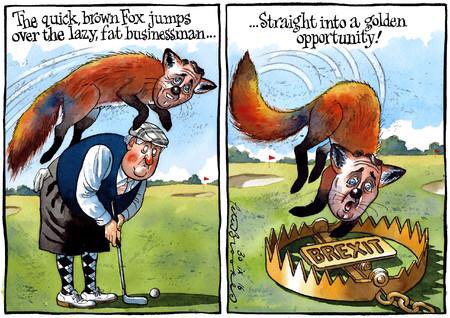
Art credit: Peter Brookes

*Reblogged from the ‘How to Crack a Nut’ blog