By Paul De Hert* and Andrés Chomczyk Penedo**
* Professor at Vrije Universiteit Brussel
(Belgium) and associate professor at Tilburg University (The Netherlands)
** PhD Researcher at the Law, Science,
Technology and Society Research Group, Vrije Universiteit Brussel (Belgium).
Marie Skłodowska-Curie fellow at the PROTECT ITN. The author has received
funding from the European Union’s Horizon 2020 research and innovation
programme under the Marie Skłodowska-Curie grant agreement No 813497
1. Dealing with online misinformation: who is in
charge?
Misinformation
and fake news are raising concerns for the digital age, as discussed by Irene
Khan, the United Nations Special Rapporteur on the promotion and protection of
the right to freedom of opinion and expression (see here). For example, during
the last two years, the COVID19 crisis caught the world by surprise and
considerable discussions about the best course of action to deal with the
pandemic were held. In this respect, different stakeholders spoke up but not
all of them were given the same possibilities to express their opinion. Online
platforms, but also traditional media, played a key role in managing this
debate, particularly using automated means (see here).
A climate of
polarization developed, in particular on the issue of vaccination but also
around other policies such as vaccination passports, self-tests, treatment of
the virus in general, or whether the health system should focus on ensuring
immunity through all available strategies (see here). Facebook, YouTube,
and LinkedIn, just to name a few, stepped in and started delaying or censoring
posts that in one way or another were perceived as harmful to governmental
strategies (see here). While
the whole COVID19 crisis deserves a separate discussion, it serves as an example
of how digital platforms are, de facto,
in charge of managing online freedom of expression and, from a practical point
of view, have the final say in what is permissible or not in an online
environment.
The term
'content’ has been paired with adjectives such as clearly illegal, illegal and
harmful, or legal but harmful, just to name the most relevant ones. However,
what does exactly each of these categories entail, and why are we discussing
these categories? What should be the legal response, if any, to a particular
piece of content and who should address it? While content and its moderation is
not a new phenomenon, as Irene Khan points in her previously mentioned report,
technological developments, such as the emergence and consolidation of
platforms, demand new responses.
With this
background, the European Union is currently discussing at a surprisingly, very
quick speed the legal framework for this issue through the Digital Services Act
(the DSA, previously summarised here).
The purpose of this contribution is to explore how misinformation and other
categories of questionable content are tackled in the DSA and to highlight the option
taken in the DSA to transfer government-like powers (of censorship) to the
private sector. A more democratic alternative is sketched. A first one is based
on the distinction between manifestly illegal content and merely illegal
content to distribute better the workload between private and public
enforcement of norms. A second alternative consists in community-based content
moderation as an alternative or complementary strategy next to platform-based
content moderation
2. What is the DSA?
The DSA (see here
for the full text of the proposal and here
for its current legislative status) is one of the core proposals in the
Commission’s 2019-2024 priorities, alongside the Digital Markets Act (discussed
here),
its regulatory ‘sibling’. It intends to refresh the rules provided for in the
eCommerce Directive and deal with certain platform economy-related issues under
a common European Union framework. It covers topics such as: intermediary
service providers liability - building up from the eCommerce Directive regime
and expanding it -, due diligence obligations for a transparent and safe online
environment -including notice and takedown mechanisms, internal
complaint-handling systems, traders traceability, and advertising practices-, risk
management obligations for very large online platforms and the distribution of
duties between the European Commission and the Member States. Many of the these
topics might demand further regulatory efforts beyond the scope of the DSA,
such as political advertisement which would be complemented by sector-specific
rules as, for example, the proposal for a Regulation on the Transparency and
Targeting of Political Advertising (see here).
As of late
November 2021, the Council has adopted a general approach to the Commission’s
proposal (see here)
while the European Parliament is still dealing with the discussion of possible
amendments and changes to that text (see here).
Nevertheless, as with many other recent pieces of legislation (see here),
it is expected that its adoption is sooner rather than later in the upcoming
months.
3. Unpacking Mis/Disinformation (part1): illegal
content as defined by Member States
We started by discussing
misinformation and fake news. If we look at the DSA proposal, the term 'fake
news' is missing in all its sections. However, the concept of misinformation appears as disinformation in Recitals 63, 68, 69,
and 71. Nevertheless, both terms are nowhere to be found in the Articles of the
DSA proposal.
In literature,
the terms are used interchangeably or are distinguished, with disinformation defined as the
intentional and purposive spread of misleading information, and misinformation as ‘unintentional
behaviors that inadvertently mislead’ (see here).
But that distinction does not help in recognizing either mis- or disinformation,
from other categories of content.
Ó Fathaigh,
Helberger, and Appelman (see here)
have pointed that disinformation, in particular, is a complex concept to tackle
and that very few scholars have tried to unpack its meaning. Despite the
different policy and scholarly efforts, a single unified definition of mis- or
disinformation is still lacking, and the existing ones can be considered as too
vague and uncertain to be used as legal definitions. So, where shall we start
looking at these issues? A starting point, so we think, is the notion of
content moderation, which according to the DSA proposal, is defined as follows:
'content moderation' means the activities undertaken by providers of
intermediary services aimed at detecting, identifying, and addressing
illegal content or information incompatible with their terms and conditions,
provided by recipients of the service, including measures taken that affect the
availability, visibility, and accessibility of that illegal content or that
information, such as demotion, disabling of access to, or removal thereof, or
the recipients' ability to provide that information, such as the termination or
suspension of a recipient's account (we underline);
Under this
definition, content moderation is an activity that is delegated to providers of
intermediary services, particularly online platforms, and very large online
platforms. Turning to the object of the moderation, we can ask what is exactly
being moderated under the DSA? As mentioned above, moderated content is usually
associated with certain adjectives, particularly illegal and harmful. The DSA
proposal only defines illegal content:
‘illegal content’ means
any information, which, in itself or by its reference to an activity, including
the sale of products or provision of services is not in compliance with Union
law or the law of a Member State, irrespective of the precise subject matter or
nature of that law;
So far, this
definition should not provide much of a challenge. If the law considers something
as, it makes sense that it is similarly addressed in the online environment as
in the physical realm. For example, a pair of fake sneakers constitute a
trademark infringement, regardless of if the pair is being sold via eBay or by
a street vendor in Madrid’s Puerta del Sol. In legal practice, regulating
illegal content is not black and white. A distinction can be made between clearly illegal content and situations where further exploration must be conducted to determine the illegality of
certain content. This is how it is framed in the German NetzDG, for example.
In some of the DSA proposal articles, mainly Art. 20, we can see the
distinction between manifestly illegal content and illegal content. However,
this distinction is not picked up again in the rest of the DSA proposal.
What stands is that
the DSA proposal does not expressly cover disinformation but concentrates on
the notion of illegal content. If Member State law defines and prohibit mis- or
disinformation -which Ó Fathaigh, Helberger and Appelman have reviewed and
found to be inconsistent across the EU- , then this would fall under the DSA
category of illegal content. Rather than creating legal certainty, this further
reinforces legal uncertainty and pegs the notion of illegal content to be
dependent on each Member State's provisions. But where does this leave disinformation
that is not regulated in in Member State laws? The DSA does not like it, but
its regulation is quasi hidden.
4. Unpacking Mis/Disinformation (part2): harmful
content non defined by the DSA
The foregoing
brings us to the other main concept dealing with content in the DSA, viz. harmful
content. To say that this is a (second) 'main' concept might confuse the
reader, since the DSA does not define it or regulate it at great lengths. The DSA’s explanatory memorandum states that `[t]here is a general agreement among
stakeholders that ‘harmful’ (yet not, or at least not necessarily, illegal)
content should not be defined in the Digital Services Act and should not be
subject to removal obligations, as this is a delicate area with severe
implications for the protection of freedom of expression’.
As such, how can
we define harmful content? This
question is not new by any means as we can trace back policy documents from the
European Union dating back to 1996 (see here)
dealing with this problem. Since then, little has changed in the debate
surrounding harmful content as the core idea remains untouched: harmful content
refers to something that, depending on the context, could affect somebody due
to it being unethical or controversial (see here).
In this respect,
the discussion on this kind of content does not tackle a legal problem but
rather an ethical, political, or religious one. As such, it is a valid question
to be asked if laws and regulations should even mingle in this scenario. In
other words, does it make sense to talk about legal but harmful content when we discuss new regulations? Should
our understanding of illegal and harmful content be construed in the most generous
way to accommodate for the most amount of situations possible to avoid this
issue? And more importantly, if the content seems to be legal, does it make
sense to add the adjective of ‘harmful’ rather than using, for example,
‘controversial’? Regardless of the terminology used, this situation leaves us
with three types of content categories: (i) manifestly illegal content; (ii)
illegal, both harmful and not, content; (iii) legal but harmful content. Each
of them demands a different approach, which shall be the topic of our following
sections.
5. Illegal content moderation mechanisms in the DSA
(content type 1 & 2)
The DSA puts
forward a clear, but complex, regime for dealing with all kinds of illegal
content. As a starting point, the DSA proposal provides for a general no monitoring regime for all
intermediary service providers (Art. 7) with particular conditions for mere
conduits (Art. 3), caching (Art. 4), and hosting service providers (Art. 5). However,
voluntary own-initiative investigations are
allowed and do not compromise this liability exemption regime (Art. 6). In any
case, once a judicial or administrative
order mandates the removal of content, this order has to be followed to
avoid incurring liability (Art. 8). In principle, public bodies (administrative
agencies and judges) have control over what is illegal and when something should
be taken down.
However, beyond
this general regime, there are certain stakeholder-specific obligations spread
out across the DSA proposal also dealing with illegal content that challenge the
foregoing state-controlled mechanism. In this respect, we can point out the mandatory
notice and takedown procedure for hosting providers with a fast lane for
trusted flaggers notices (Arts. 14 and 19, respectively), in addition to the
internal complaint-handling system for online platforms paired with the
out-of-court dispute settlement (Arts. 17 and 18, respectively) and, in the
case of very large online platforms, these duties should be adopted following a
risk assessment process (Art. 25). With these set of provisions, the DSA grants
a considerable margin to certain entities to act as law enforcers and judges,
without a government body having a say in if something was illegal and its
removal was a correct decision.
6. Legal but harmful content moderation mechanisms in
the DSA (content type 3)
But what about our
third type of content, legal but harmful content, and its moderation? Without
dealing with the issue of content moderation directly, the DSA transfers the
delimitation of this concept to providers of online intermediary services,
mainly online platforms. In other words, a private company can limit apparently
free speech within its boundaries. In this respect, the DSA proposal grants all
providers of intermediary services the possibility of further limiting what
content can be uploaded and how it shall be governed via the platform’s terms
and conditions and, by doing so, these digital services providers are granted
substantial power in regulating digital behavior as they see fit:
‘Article 12 Terms and conditions
1. Providers of intermediary services shall include information on any
restrictions that they impose concerning the use of their service in
respect of information provided by the recipients of the service, in their
terms and conditions. That information shall include information on any
policies, procedures, measures, and tools used for content moderation,
including algorithmic decision-making and human review. It shall be set out in
clear and unambiguous language and shall be publicly available in an easily
accessible format.
2. Providers of intermediary services shall act in a diligent,
objective, and proportionate manner in applying and enforcing the restrictions
referred to in paragraph 1, with due regard to the rights and legitimate
interests of all parties involved, including the applicable fundamental rights
of the recipients of the service as enshrined in the Charter.’
In this respect,
the DSA consolidates a content moderation model heavily based around providers
of intermediary services, and in particular, very large online platforms, acting
as lawmakers, law enforcers, and judges at the same time. They are lawmakers as
the terms and conditions lay down what is permitted as well as forbidden in the
platform. While there isn't a general obligation to patrol the platform, they must
react to notices from users and trusted flaggers and enforce the terms if
necessary. And, finally, they act as judges by attending to the replies from
the user who uploaded illegal content and dealing with the parties involved in
the dispute, notwithstanding the alternative means provided for in the DSA.
Rather than
using the distinction between manifestly illegal content and ordinary illegal
content and refraining from regulating other types of content, the DSA creates
a governance model for moderation of all content in the same manner. While
administrative agencies and judges can request content to be taken down, under
Art. 8, the development of the further obligations mentioned above poses the
following question: who is the main responsible to define what is illegal and
what is legal? Are the existing institutions subject to checks and balances or
rather private parties, particularly BigTech and very large online platforms?
7. The privatization of content moderation: the second
(convenient?) invisible handshake between the States and platforms
As seen with
many other areas of the law, policymakers and regulators have slowly but
steadily transferred government-like responsibilities into the private sector
and mandated their compliance relying on a risk-based approach. For example, in
the case of financial services, banks, and other financial services providers
have turned into the long arm of financial regulators to tackle money
laundering and tax evasion rather than relying on government resources to do
this. This resulted in financial services firms having to process vast amounts
of personal data to determine whether a transaction is illegal (either because
it is laundering criminal proceedings or avoiding taxes) with nothing but their
planning and some general guidelines; if they fail in this endeavor
administrative fines (and in some cases, criminal sanctions) can be expected. The
result has been an ineffective system to tackle this problem (see here)
yet regulators keep on insisting on this approach.
A little shy of
20 years ago, Birnhack and Elkin denounced the existence of an invisible
handshake between States and platforms for the protection and sake of national
security after the 9/11 terror attacks (see here).
At that time, this invisible handshake could be considered by some as necessary
to deal with an international security crisis. Are we in the same situation as
we speak when it comes to dealing with disinformation and fake news? This is a
valid question. The EU policy makers seems to be impressed by voices such as
Facebook’s whistleblower Frances Haugen who wants to align 'technology and
democracy' by enabling platforms to moderate post. The underlying assumption
seems to be that platforms are in the best position to moderate content
following supposedly clear rules and that 'disinformation' can be identified (see
here).
Content
moderation presents a challenge for States given the amount of content
generated non-stop across different intermediary services, in particular,
social media online platforms (see here).
Facebook employs a sizable staff of almost 15,000 individuals as content
moderators (see here)
but also relies heavily on automated content moderation, authorized by the DSA proposal
under Arts. 14 and 17, in particular, to mitigate mental health problems to
those human moderators given the inhuman content they sometimes have to engage
with. To put this in comparison, using the latest available numbers from the Council
of Europe about the composition of judiciary systems in Europe (see here),
the Belgian judiciary employs approximately 9200 individuals (-the entire
judiciary dealing with issues about commercial law up to criminal cases-), a
little more than half of Facebook’s content moderators.
As such, one can
argue that courts could be easily overloaded with cases that demand a quick and
agile solution for defining what is illegal or harmful content if platforms
didn't act as a first-stage filter for content moderation. Governments would
need to heavily invest in administrative or judicial infrastructure and human
resources to deal with such demand from online users. This matter has been discussed
by scholars (see here).
The available options they see either (i) strengthening platform content
moderation by requiring the adoption of judiciary-like governance schemes, such
as social media councils as Facebook has done; or (ii) implementing e-courts
with adequate resources and procedures suited to the needs of the digital age
to upscale our existing judiciary.
8. The consequences of the second invisible handshake
The DSA seems to
have, willingly or not, decided on the first approach. Via this approach, -the
privatization of content moderation-, States do not have to deal with the lack
of judicial infrastructure to deal with the amount of content moderation that
digital society requires. As shown by our example, Facebook has an
infrastructure, just on raw manpower available, that doubles that of a
country’s judiciary, such as Belgium. This second invisible handshake between
BigTech and States can be situated in the incapacity of States to deal with disinformation
effectively with the current legal framework and institutions.
If the DSA
proposal is adopted ‘as is’, then platforms would have a significant power over
individuals. First, through the terms and conditions, they would in position to
determine what is allowed to be said and what cannot be discussed, as provided
for by Art. 12. Not only that but also any redress before decisions adopted by
platforms would have to be first channeled through the internal complaint
handling mechanisms, as provided for by Arts. 17 and 18, for example, rather
than seeking judicial remedy. As it can be appreciated, the power scale has
clearly shifted towards platforms, and by extension to governments, in
detriment of end-users.
Besides this,
the transfer of government-like powers to platforms contributes to avoiding
making complicated and hard decisions that could cost political reputation.
Returning to our opening example, the lack of a concrete decision from our
governments regarding sensitive topics has left platforms in charge of choosing
what is the best course of action to tackle a worldwide pandemic by defining
when something is misinformation that can affect the public health and when something
could help fight back something that is out of control. Not only that but if
platforms wrongfully approach the issue, then they are exposed to fines for
non-compliance with their obligations, although particularly very large online
platforms can deal with the fines proposed under the DSA.
If the second
invisible handshake is going to take place, the least we, as a society, deserve
is that agreement is made transparent so that public scrutiny can oversight
such practices and free speech can be safeguarded. In this respect, the DSA
could have addressed the issue of misinformation and fake news in a more
democratic manner. Two proposals:
9. Addressing disinformation more democratically to
align 'technology and democracy'
Firstly, the distinction
between manifestly illegal content and merely illegal content could have been
extremely helpful in distributing the workload between the private and public
sector in a manner that administrative authorities and judges would only take
care of cases where authoritative legal interpretation is necessary. As such,
manifestly illegal content, such as apology to crime or intellectual property
infringements, could be handled directly by platforms and merely illegal
content by courts or administrative agencies. In this respect, a clear
modernization in legal procedures to deal with claims about merely illegal
content would still be necessary to adjust the legal response time to the speed
of our digital society. Content moderation is not alone in this respect but
joins the ranks of other mass-related issues, such as consumer protection,
where effective legal protection is missing due to the lack of adequate
infrastructure to channel complaints.
Secondly, as for legal but
harmful content, while providers of online intermediary services have a right
to conduct their business as to how they see fit and therefore can select which
content is allowed or not via terms and conditions, citizens do have a valid
right to engage directly in the discussion of those topics and determine how to
proceed with them. This is even more important as users themselves are the ones
interacting on these platforms and that content is exploited by platforms to
ensure that controversy remains on the table to ensure engagement (see here).
However, there
is a possibility to deal with content moderation, particularly in the case of
legal but harmful content, that avoids a second invisible handshake: community-based
content moderation strategies (see here)
where users have a more active role in the management of online content has
proven to be successful in certain online platforms. While categories such as clearly illegal or illegal and harmful
content do not provide much margin for societal interpretation, legal but harmful content could be
tackled by citizens' involvement. In this respect, community-based approaches,
while resource-intensive, allow for citizens to engage directly in the debate about
the issue at hand.
While
community-based content moderation also has its own risks, it could serve as a
more democratic method than relying on platforms’ unilateral decisions and it
might serve where judges and administrative agencies cannot go due to the legality
of content. As noted by the Office of the United Nations High Commissioner for
Human Rights, people, rather than technology, should be making the hard
decisions but also States, as elective representatives of society, need to make
decisions about what is illegal and what is legal (see here).
Our alternatives
are only a part of a more complete program. Further work is needed at policy
level to address fake news. Sadly, as it may be, the matter is not matured yet
and ripe for regulation. While the phenomena of political actors actively
spreading misleading information (the twittering lies told by political
leaders) are well-known and discussed, the role of traditional news media, who
are supposed to be the bearers of truth and factual accuracy, is less well
understood. Traditional news media are in fact a part of the problem, and play
a somewhat paradoxical role with respect to fake news and its dissemination.
People learn about fake news, not via obscure accounts that Facebook and others
can control, but through regular media that find it important for many reasons
to report on disinformation. Tsfatie and others (see here)
rightly ask for more analysis and collaborations between academics and
journalists to develop better practices in this area.
We are also surprised
by the lack of attention in the DSA proposal to the
algorithmic and technological dimension that seems central to the issue of
fake news. More work is needed on the consequences of algorithmic production of
online content. More work too is needed to assess the performance of
technological answers to technology. How
to organize a space of contestation in a digitally mediated and enforced world?
Are the redress mechanisms in the DSA sufficient when the post has already been
deleted, i.e. "delete first rectify after"?
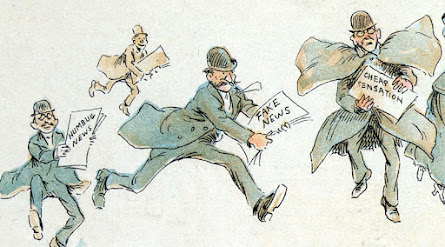
Art credit: Frederick
Burr Opper, via wikimedia
commons


.jpg)